

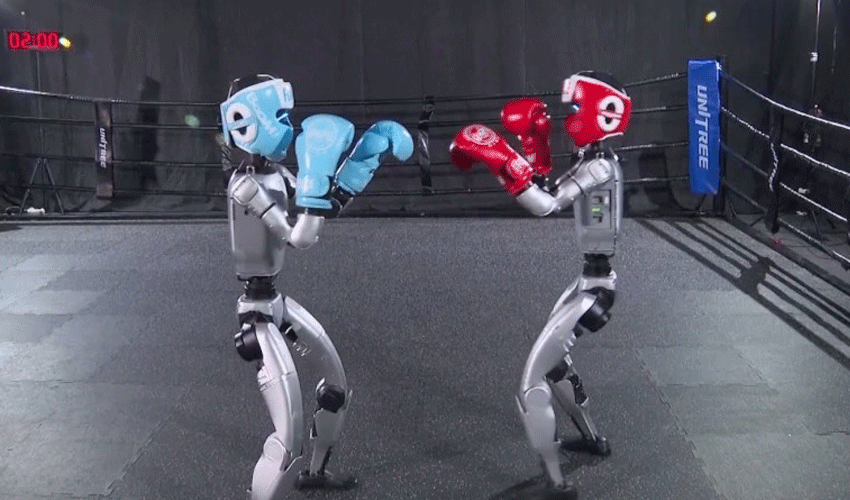

In a historic first for both robotics and sports, humanoid robots battled it out in a live martial arts competition held Sunday in Hangzhou, eastern China. The groundbreaking event marked a major step forward in human-like robotics and competitive entertainment.
The matches were part of the China Media Group (CMG) World Robot Contest and took place at the Hangzhou Olympic Sports Center. The combatants — agile, human-shaped machines — were developed by Hangzhou-based tech company Unitree Robotics.
Billed as the “Mech Combat Arena Competition,” the contest included both exhibition and head-to-head matches, streamed to a global audience. The event showcased not just raw robotic power, but also the intricacy of engineering that allowed these machines to throw punches, dodge attacks, and recover from falls in real time.
Each robot was equipped with advanced motion control systems capable of executing a range of complex martial arts techniques, including jabs, hooks, and sidekicks. Organizers emphasized the technological challenge of achieving such agility, especially when it comes to real-time posture recovery after being knocked down — still a frontier in robotic motion.
“Executing a fast leg swing demands split-second sensory processing and joint coordination,” explained Sun Baoyan, marketing manager at Unitree Robotics. “The system has to process data from internal sensors in milliseconds, ensuring stability and endurance under pressure.”
Wang Qixin, a board member at Unitree Robotics, noted the considerable engineering challenges of designing robots for high-impact sport. “We had to develop custom motion control algorithms tailored to combat scenarios. Building anti-fall mechanisms alone took intensive testing and development,” he said.
All components — both hardware and software — used in the robots were developed in China, reflecting the country’s accelerating advances in artificial intelligence and robotics.
To enhance the viewer experience, CMG employed cutting-edge broadcast technologies, including augmented and virtual reality elements, as well as multi-angle free-view cameras. “We wanted the livestream to feel immersive — not just a match, but a futuristic showcase of visual and technological innovation,” said Jiang Hua, the event’s technical director.
Expert commentators and robotics analysts provided real-time insights during the event, explaining the mechanical strategies and engineering behind each move — making the competition both a spectacle and an educational journey into the future of robotic sports.
