

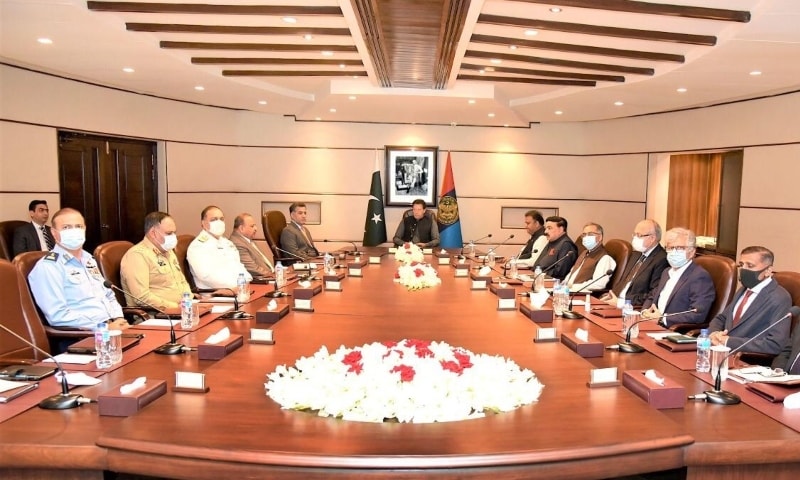

ISLAMABAD: The long-awaited National Intelligence Coordination Committee (NICC), the liaison body for the country’s spy agencies, is finally functional.
Prime Minister Imran Khan on Wednesday presided over the inaugural session of the committee at the Inter-Services Intelligence (ISI) headquarters.
The meeting was attended by Interior Minister Sheikh Rashid Ahmed, Information Minister Fawad Chaudhry, heads of the services’ intelligence agencies, Intelligence Bureau and Federal Investigation Agency.
“A comprehensive briefing followed by discussion on enhanced intelligence cooperation was held. Prime Minister appreciated the ongoing efforts and expressed satisfaction over the performance of National Intelligence Coordination Committee,” the Prime Minister Office (PMO) said in a statement on the meeting.
The Director General of ISI would be convener of the NICC, whereas a senior official of IB would serve as its secretary.
Officers from ISI are expected to initially provide the secretarial support for the new body. However, a security official said, a separate secretariat would be subsequently set up.
The forum was officially notified on Jan 22 as “a platform for Intelligence Coordination/ Cooperation for unified and wholesome National Intelligence Assessment”.
Discussions on the establishment of NICC were held late last year and the prime minister had approved the new forum in November.
Several efforts were made in the past for such a coordination structure, but failed because of differences over its leadership and turf wars between different agencies.
There are over two dozen intelligence organisations in the country. The setting up of the NICC as part of the long-awaited reform of the intelligence apparatus is expected to improve their coordination and optimise their capabilities.
A security official said the NICC would give “collated intelligence input” to the prime minister.
One of the lessons learnt by the country during the fight against terrorism was that effective intelligence coordination was the weakest link in the entire effort. It importantly resulted in loss of critical time and in some cases, the agencies could not even piece together the information available to them. It was, moreover, a major hurdle to collective strategising.
A leaked version of the Abbottabad Commission’s report had revealed that the commission, while noting the absence of civil-military intelligence coordination mechanism, too had proposed establishment of an agency on the lines of the US Department of Homeland Security to synergise the working of main spy agencies in the country.
