

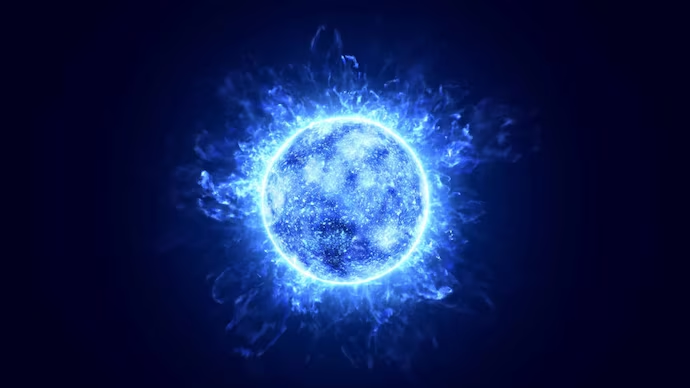

Rare Cosmic Event
Astronomers have revealed that T Coronae Borealis, a star located in the Northern Crown constellation, is on the verge of a massive nova explosion. This rare event, which occurs once every 80 years, presents a unique opportunity for stargazers and astronomy enthusiasts worldwide.
The explosion will be so bright that it will be visible to the naked eye without the need for telescopes, making it a historic celestial occurrence not seen since 1946.
T Coronae Borealis: A Unique Celestial Event
T Coronae Borealis, also known as the “Blaze Star,” is part of a binary star system composed of a red giant and a white dwarf. The red giant, nearing the later stages of its lifecycle, is gradually shedding material into space. Meanwhile, the white dwarf, which has already exhausted its nuclear fuel, is continuously pulling in this material from its companion.
Over time, as the white dwarf accumulates more of the red giant’s matter, an immense build-up of pressure and heat occurs, eventually triggering a thermonuclear explosion.
This sudden and powerful reaction results in a dramatic increase in brightness, causing the star to appear much more luminous in the night sky. This phenomenon, known as a nova, is distinct from a supernova, as it does not completely destroy the white dwarf but instead allows the cycle to repeat over centuries.
When Will the Nova Be Visible?
Experts suggest that this spectacular explosion may take place on March 27, though the exact timing remains uncertain. Once the nova occurs, it could be visible for several nights, shining as brightly as the North Star. If the predictions hold true, skywatchers around the world will have the chance to witness an extraordinary cosmic display.
Previous Sightings of the Nova
Historical records indicate that T Coronae Borealis underwent similar explosive events in 1787, 1866, and 1946. These observations confirm that this nova follows a relatively predictable pattern, much like Halley’s Comet, which orbits close to Earth approximately every 76 years. This periodic recurrence makes T Coronae Borealis one of the few novae that scientists can anticipate with reasonable accuracy.
Expert Insights and Observations
According to Frank Marchis, a senior planetary astronomer at the SETI Institute, astronomers have been closely monitoring T Coronae Borealis since September. Recent observations suggest that the conditions necessary for an impending nova are aligning, although this remains a theoretical prediction.
Since cosmic events of this nature are complex, astronomers cannot determine the exact moment the explosion will occur, but the signs strongly indicate that it is imminent.
Dr. Hounsell, a researcher at NASA’s Goddard Space Flight Center, emphasized the significance of this event, describing it as a “once-in-a-lifetime” opportunity.
She believes that such celestial phenomena can inspire the next generation of astronomers, encouraging them to engage in scientific inquiry, observe the universe firsthand, and collect valuable data.
For those fascinated by astronomy, the upcoming nova event offers a remarkable chance to witness a rare and awe-inspiring spectacle. If the explosion occurs as predicted, millions of people will be able to look up at the night sky and observe a star shining brighter than ever before—an unforgettable glimpse into the dynamic and ever-changing cosmos.
