

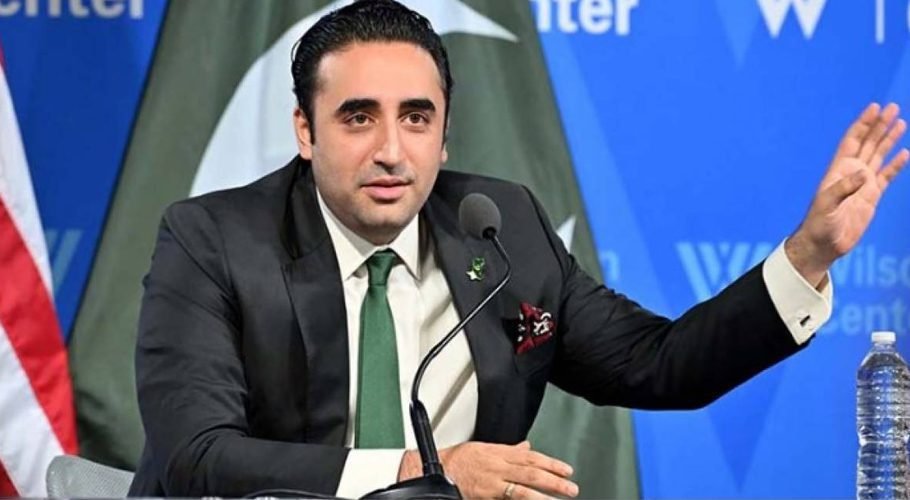

ISLAMABAD: Pakistan can serve as a bridge between China and the United States, according to Bilawal Bhutto Zardari, Chairman of the Pakistan Peoples Party, as the world witnesses a paradigm shift with rising tensions between the two global powers.
In an interview with DW at the Munich Security Conference (MSC), Bilawal spoke about the increasing competitiveness between the U.S. and China, highlighting its global impact. “The pace of that competitiveness has palpable effects all over the world. You’re feeling it here in Munich at the MSC, and most of the world is engaged in that competitiveness,” he said.
When asked whether Pakistan felt the need to align itself with one side, Bilawal emphasized that Pakistan has historically played the role of a bridge builder, rather than a divisive force. “From a Pakistani perspective, we have historically played the role of a bridge builder rather than a dividing force. Some countries may profit from the increasing competitiveness between the U.S. and China, but Pakistan has maintained a different position,” he explained.
During the three-day conference in Munich, the Munich Security Report explored the “multipolarisation” of the world and analyzed the risks such a situation poses to peace, prosperity, and collaborative efforts to address global threats.
Bilawal reaffirmed that Pakistan aims to continue its role as a neutral intermediary, stating, “If Pakistan were to be placed in a camp, we would prefer to see ourselves as bridge builders, a role we have historically played in connecting the two superpowers.” He added that Pakistan’s goal is to close the gap between the U.S. and China, rather than intensify any divisions.
Reflecting on Pakistan’s historical diplomatic contributions, Bilawal referenced former U.S. Secretary of State Dr. Henry Kissinger’s recognition of Pakistan’s key role in facilitating a breakthrough in China-U.S. relations in the early 1970s. In a speech marking “50 Years of China-U.S. Relations,” Kissinger praised Pakistan’s diplomatic efforts during a pivotal time in international relations, particularly Pakistan’s role in facilitating secret communications between China and the United States. This effort culminated in President Richard Nixon’s historic visit to China in 1972, a move facilitated by then-President Yahya Khan and Pakistani officials.
When asked about the possibility of facilitating a similar role under the Trump administration, Bilawal expressed confidence in U.S. President Donald Trump’s “dealmaker” approach. “President Trump is a dealmaker, and I believe Pakistan can engage with the U.S. in areas such as peace efforts with India or trade talks, given the current global challenges,” he stated.
Regarding the growing U.S.-India relationship, Bilawal acknowledged the complexities of the situation, particularly in the context of the China-U.S. conflict. He remarked, “With the U.S. attempting to build up India as a counterweight to China, it does upset the regional balance of power. It also has implications for the arms race between India and Pakistan.” He emphasized that both Pakistan and India face significant challenges, such as poverty and unemployment, and that Pakistan would maintain its stance to ensure its security.
Bilawal’s remarks also touched on broader international relations, including Pakistan’s interactions with the West. He responded to a question about the U.S. Vice President JD Vance’s speech at the MSC, noting that Pakistan was not surprised by the U.S. prioritizing its own interests. “We’re used to the fact that the U.S. always looks after its own interests first,” he said. He drew parallels to the U.S. withdrawal from Afghanistan under Trump, noting how the decision was made without consulting neighboring countries or European allies.
“The old norms of how the world interacts are changing,” Bilawal observed. “Europe is still learning how to engage with these shifts, and Pakistan too must adapt to these new realities.” He added that Pakistan’s strong economic ties with both China and the West are not mutually exclusive. Bilawal pointed out the growing trade relations between Pakistan and Europe as evidence that business with China does not mean cutting off Pakistan from the rest of the world.
In conclusion, Bilawal Bhutto Zardari reiterated that Pakistan’s historic role as a bridge builder continues to define its foreign policy. While tensions between global powers may be rising, Pakistan aims to maintain its stance as a neutral mediator, fostering dialogue and cooperation rather than contributing to division.
