
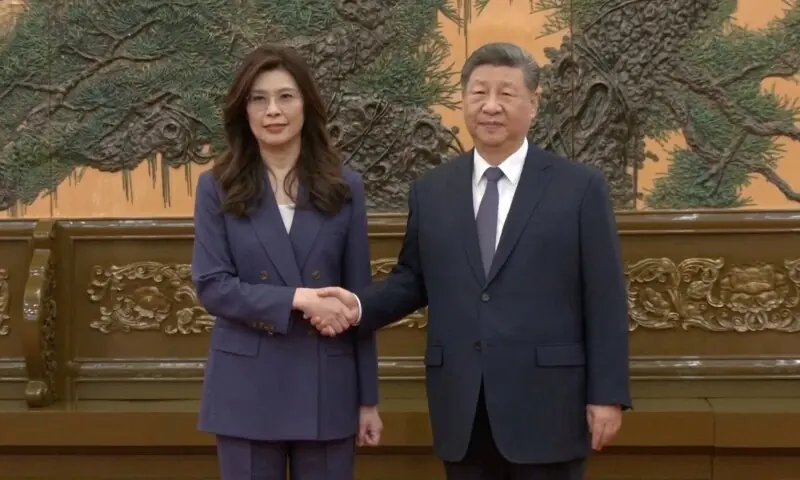

High-Level Talks Signal Renewed Cross-Strait Engagement
Chinese President Xi Jinping met with Cheng Li-wun, leader of Taiwan’s opposition Kuomintang (KMT), in Beijing on Friday, expressing strong confidence in eventual unity between people on both sides of the Taiwan Strait. Cheng’s visit marks the first time in a decade that a KMT leader has traveled to mainland China, drawing both attention and controversy in Taiwan. Critics within the island have questioned her approach, accusing her of aligning too closely with Beijing’s positions.
During the meeting, Xi emphasized that closer ties between China and Taiwan are part of an “inevitable historical trend,” stating that mutual cooperation and eventual unification remain unchanged goals. He reiterated China’s willingness to engage with Taiwanese groups that share opposition to independence, signaling openness to continued dialogue under common political understandings.
Political Divides and Calls for Peaceful Dialogue
Relations between China and Taiwan have remained strained since 2016, when Tsai Ing-wen from the Democratic Progressive Party (DPP) assumed office and rejected Beijing’s territorial claims over the self-governed island. Since then, official communication between the two sides has largely been suspended.
Following her meeting with Xi, Cheng echoed similar sentiments, urging younger generations to recognize current geopolitical challenges and support frameworks such as the “1992 Consensus,” which acknowledges the idea of “one China” without defining its representation. She stressed that adherence to this principle could help prevent conflict and reduce tensions in the region. Cheng also proposed expanding Taiwan’s participation in international organizations like Interpol and regional trade agreements, noting that Xi responded positively to these suggestions.
Rising Tensions Amid Military Pressure and Policy Disputes
Despite diplomatic overtures, tensions in the Taiwan Strait continue to rise. Beijing has increased military activities around Taiwan, including frequent deployments of fighter jets and naval vessels, raising concerns about regional stability. In response, Taiwanese leaders, including current President Lai Ching-te, have warned that such actions undermine peace and security.
Meanwhile, internal political disagreements persist within Taiwan over defense spending. Opposition lawmakers, including those from the KMT, have resisted a proposed $39 billion defense budget, favoring a more limited allocation. The debate has also drawn involvement from the United States, which has encouraged Taiwan to strengthen its military capabilities to deter potential threats from China.
Cheng’s visit, which included stops in Shanghai and Nanjing—where she paid tribute to Sun Yat-sen—comes at a sensitive time, just ahead of a planned summit between Xi and former U.S. President Donald Trump. The trip highlights both the complexities and the urgency of managing cross-strait relations amid shifting regional dynamics.

