

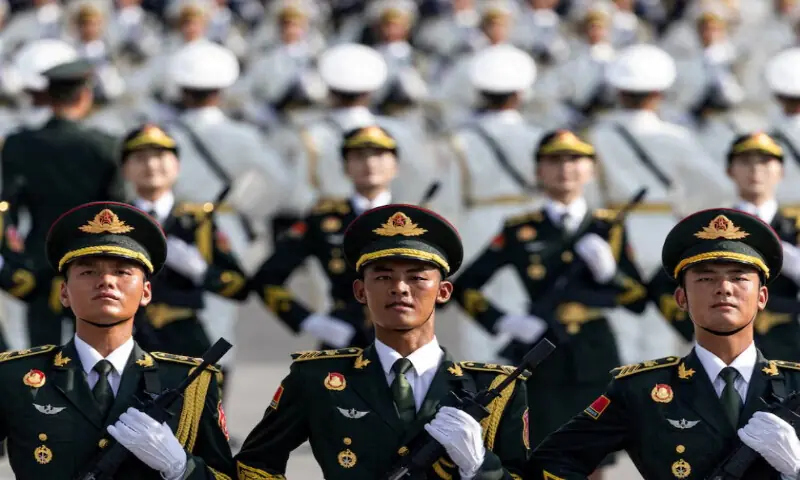

Chinese President Xi Jinping will be flanked by leaders of some of the world’s most heavily sanctioned nations — Russia, North Korea, Iran, and Myanmar — at a grand military parade in Beijing next week, signaling a united front against the West.
The September 3 “Victory Day” parade, marking Japan’s formal surrender in World War II, will see Russian President Vladimir Putin and North Korean leader Kim Jong-Un standing beside Xi for the first time in public. Iranian President Masoud Pezeshkian is also expected to attend, along with Myanmar’s junta chief Min Aung Hlaing, in what analysts are describing as the formation of an “Axis of Upheaval.” Tens of thousands of Chinese troops are set to march through the capital in one of the country’s largest parades in years.
Western leaders will be largely absent from the 26 foreign heads of state and government attending. The few exceptions include Slovakia’s Prime Minister Robert Fico and Serbia’s President Aleksander Vucic, both of whom maintain warmer ties with Moscow and Beijing than with Brussels. Fico has opposed EU sanctions on Russia over the Ukraine war, while Vucic continues to pursue EU membership for Serbia while simultaneously strengthening relations with Russia and China.
Analysts suggest Xi’s move reflects his growing influence over nations intent on reshaping the Western-led order. “Xi Jinping is trying to showcase that he is very strong, that he is still powerful and well received in China,” said Alfred Wu, Associate Professor at the Lee Kuan Yew School of Public Policy, National University of Singapore. He added that Xi, once inspired by Putin’s leadership style, now positions himself as a global figure, underscored by his ability to stand alongside both Putin and Kim.
This loose coalition — Russia, North Korea, Iran, and Myanmar — has long sought to resist U.S. interests, whether through tensions over Taiwan, disruptions to shipping routes, or by providing each other with economic lifelines to bypass Western sanctions.
Russia, facing deep sanctions after its 2022 invasion of Ukraine, remains a key strategic partner for Beijing, even as its economy teeters on the edge of recession. Putin, wanted by the International Criminal Court for war crimes linked to the deportation of Ukrainian children, last visited China in 2024. Meanwhile, North Korea, China’s formal treaty ally, has faced U.N. sanctions since 2006 for its nuclear weapons program, with Kim making his last trip to China in January 2019.
China itself continues to prop up its partners: it buys nearly 90% of Iran’s sanctioned oil exports and sources rare earth minerals critical for technology and renewable energy from Myanmar.
Other attendees at the Beijing parade include Belarusian President Aleksandr Lukashenko, Indonesian President Prabowo Subianto, and South Korea’s National Assembly Speaker Woo Won-shik, according to Chinese Assistant Foreign Minister Hong Lei. The United Nations will be represented by Under-Secretary-General Li Junhua, a veteran Chinese diplomat. Former Japanese Prime Minister Yukio Hatoyama is also expected, though no current leaders from Germany or Italy — Japan’s former Axis allies — are on the guest list.
Through this display, Xi is expected to signal not only China’s military might but also its leadership of a bloc that openly challenges Western dominance in global affairs.
