

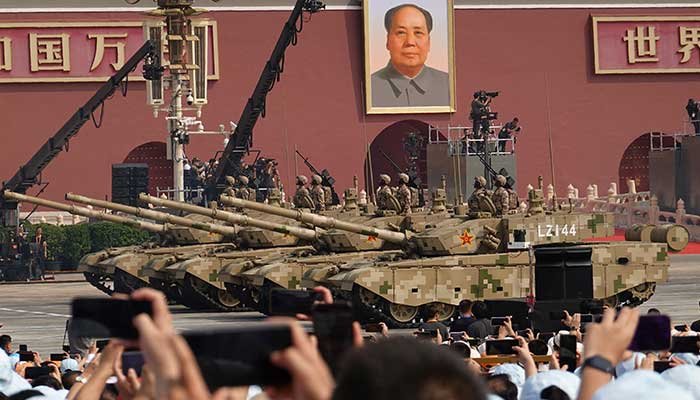

Chinese President Xi Jinping showcased China’s growing military and diplomatic influence during the country’s largest-ever military parade on Wednesday, declaring that the nation’s rise is “unstoppable.” The event, held in Beijing’s iconic Tiananmen Square, marked the 80th anniversary of Japan’s defeat in World War II and was attended by key allies including Russian President Vladimir Putin and North Korean leader Kim Jong Un.
In a speech before more than 50,000 spectators, Xi said, “Today, mankind is faced with the choice of peace or war, dialogue or confrontation, win-win or zero-sum.” The Chinese leader, dressed in a Mao-style suit, emphasized that the Chinese people “firmly stand on the right side of history.” He then rode through the square in an open-top limousine, inspecting troops and advanced military equipment including missiles, tanks, and drones.
Western leaders were noticeably absent, with the event seen as a symbolic show of strength amid tense US-China relations, escalating military alliances in Asia, and ongoing global instability.
Military Spectacle and Political Symbolism
The 70-minute display featured fighter jets, helicopters trailing banners, and the release of 80,000 peace doves and balloons. Seated between Putin and Kim, Xi held several informal conversations with the two, highlighting a growing axis of cooperation among nations at odds with the West.
North Korea’s Kim Jong Un attended his first Chinese military parade in over six decades, accompanied by his daughter Ju Ae, widely believed to be his potential successor. Meanwhile, Russia reportedly used the occasion to advance energy deals with Beijing.
Analysts warn the parade may signal deeper military cooperation among China, Russia, and North Korea — a development with implications for the Asia-Pacific’s security balance.
A Modern Military Amid Internal Challenges
While the parade celebrated China’s military modernization, it also took place under the shadow of an ongoing corruption crackdown within the People’s Liberation Army (PLA). More than a dozen senior generals, many formerly close to Xi, have been purged in recent months.
“The parade allows Xi to spotlight military progress while downplaying internal instability,” noted Jon Czin of the Brookings Institution. Local officials across China were reportedly required to watch the event and submit written reflections, underscoring its importance as a political rallying point.
Xi has also used recent international forums to promote a new global order rooted in opposition to “hegemonism,” in a clear reference to the United States. President Asif Ali Zardari of Pakistan congratulated China on the anniversary, reaffirming strong bilateral ties.
Security was tight in Beijing, with major roads closed, schools shuttered, and thousands of Communist Party volunteers deployed to maintain order during the high-profile gathering.
