

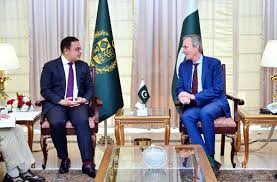

ISLAMABAD: Pakistan and the World Bank have agreed to collaborate on a robust and ambitious Country Partnership Framework (CPF) to advance the country’s reform and development agenda.
The agreement was reached during a meeting between Prime Minister Shehbaz Sharif and a delegation led by Martin Raiser, the Regional Vice-President of the World Bank for South Asia, on Wednesday.
Prime Minister Shehbaz welcomed Martin Raiser and praised the World Bank’s contribution to Pakistan’s development. He also appreciated the bank’s support in building climate-resilient infrastructure following the 2022 floods.
The prime minister briefed the delegation on the government’s reform agenda, including digitization of the tax system, power sector reforms, increasing agricultural yield per acre, and addressing child stunting.
Martin Raiser commended Pakistan’s reform agenda and expressed the World Bank’s readiness to collaborate in the country’s economic transformation for sustainable development.
Both sides agreed on a long-term partnership under a new Country Partnership Framework, with an annual review mechanism to ensure progress and flexibility for adjustments. The partnership aims to achieve transformational impacts over a decade on critical development priorities for Pakistan.
The initial priorities discussed included structural economic reforms, human capital development focusing on child stunting and education, energy sector reforms for cheaper and cleaner energy, and collaboration in climate adaptation to cope with water scarcity and climate-related shocks.
Pakistan will benefit from the World Bank’s expertise in mobilizing global knowledge and best practices, capacity building, digital transformation, and private sector participation, including through the International Finance Corporation and the Multilateral Investment Guarantee Agency.
The process for preparing the new Country Partnership Framework will involve consultations with federal and provincial governments, academia, parliamentarians, civil society, development partners, and the private sector.
The World Bank will coordinate with stakeholders to align partnership priorities with Pakistan’s key development strategies.
The signing of a joint communique was witnessed by the prime minister, the World Bank’s Country Representative Najy Benhassine, and Secretary of Economic Affairs Division Dr. Kazim Niaz. Other officials including Economic Affairs Minister Ahad Khan Cheema, Finance Minister Muhammad Aurangzeb, Petroleum Minister Dr. Musadik Malik, Minister of State for IT Shaza Fatima Khawaja, Deputy Chairman of Planning Commission Dr. Jehanzeb Khan, and senior government officials also attended the meeting.
