
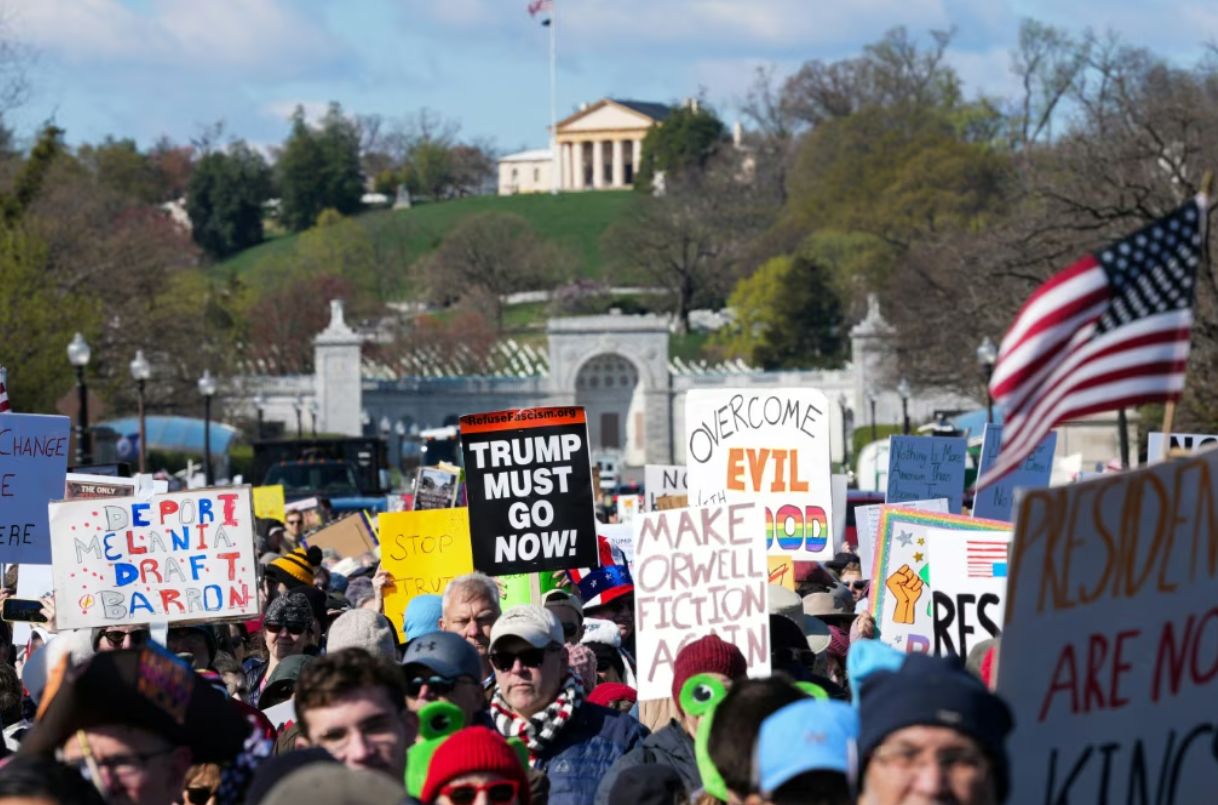

Massive protests against President Donald Trump erupted across the United States on Saturday. Millions of demonstrators gathered to express anger over policies they consider authoritarian. The demonstrations marked another major moment of public resistance during Trump’s second presidential term.
Protesters assembled in major cities including Washington, Boston, and Atlanta. Crowds filled parks, streets, and public landmarks while chanting slogans defending democratic values. Many participants said they feared growing threats to constitutional norms and civil liberties.
The protests formed part of the grassroots movement known as “No Kings.” This movement has become a central platform for opposition since Trump returned to office in January 2025. Organizers describe it as a nationwide effort promoting accountability and democratic governance.
Iran War Fuels Fresh Public Anger
This year’s demonstrations gained momentum due to the ongoing war against Iran. Critics argue that shifting military objectives created uncertainty and heightened public anxiety. As a result, anti-war sentiment blended with broader political dissatisfaction.
Many protesters said foreign policy decisions should reflect public consent. They also questioned whether military escalation aligned with campaign promises emphasizing peace. Consequently, war developments intensified already strong political divisions.
Veterans and activists joined rallies, emphasizing concerns about long-term consequences of military conflict. Participants repeatedly called for diplomacy instead of expanded military engagement.
Voices From the Streets
Across protest locations, demonstrators shared deeply personal motivations. A military veteran attending a rally in Atlanta said citizens felt constitutional protections were under pressure. He explained that many Americans no longer viewed the political climate as normal.
In Michigan’s West Bloomfield area, protesters gathered despite freezing temperatures. Their presence highlighted the determination driving the movement’s supporters. Meanwhile, marchers in Washington carried banners criticizing authoritarianism and demanding political change.
Participants walked toward the Lincoln Memorial, a historic site linked with civil rights activism. The symbolism reinforced comparisons between past struggles and current political debates.
Protests Spread Beyond American Borders
Anti-Trump demonstrations extended far beyond the United States. Rallies took place in several European cities, including Amsterdam, Madrid, and Rome. Large crowds marched while police monitored gatherings under heightened security measures.
Participants abroad said they feared global political consequences tied to American leadership decisions.
Many argued that international stability depends heavily on US political direction. Therefore, overseas protests reflected growing global engagement with American domestic politics.
Growth of the “No Kings” Movement
The “No Kings” protests first gained national attention during demonstrations held last June.
That initial protest coincided with a military parade organized in Washington.
Millions participated across cities ranging from New York to San Francisco.
A second nationwide protest followed in October, drawing an estimated seven million participants.
Organizers now aim to surpass previous turnout levels.
They believe expanding participation signals increasing public frustration.
Supporters argue Trump governs heavily through executive orders and aggressive policy enforcement.
Critics also oppose changes to diversity programs and environmental policies.
Additionally, opponents question the administration’s expanded use of military power abroad.
Political Stakes Rise Ahead of Midterm Elections
The demonstrations arrive during a politically sensitive period.
Trump’s approval rating has fallen below forty percent, according to organizers’ claims.
Meanwhile, midterm elections scheduled for November could reshape congressional control.
Political analysts expect protests to influence voter mobilization efforts.
Large demonstrations often energize supporters while sharpening political divides.
Therefore, protest turnout may play an indirect role in electoral momentum.
Cultural Figures Join the Movement
Minnesota emerged as a focal point for this protest wave.
The state previously became central to national debates over immigration enforcement policies.
Organizers planned numerous rallies throughout urban and rural communities.
Musician Bruce Springsteen scheduled a performance in St. Paul supporting demonstrators.
He wrote a protest song honoring two citizens killed during earlier immigration-related protests.
The performance symbolized how cultural voices increasingly intersect with political activism.
A Movement Expanding Beyond Cities
Organizers reported more than 3,000 rallies planned nationwide. Events appeared not only in major metropolitan centers but also suburban and rural areas. Even remote communities participated, demonstrating widening geographic support.
Notably, organizers said two-thirds of participants live outside major cities. This shift suggests opposition is spreading beyond traditional political strongholds. Consequently, the movement now reflects broader national engagement rather than urban activism alone.
A Deepening Political Divide
Supporters of Trump continue backing his “Make America Great Again” agenda with strong loyalty. However, critics oppose him with equal intensity across the political spectrum. This polarization highlights America’s widening ideological divide.
Protesters argue their goal is preserving democratic institutions rather than supporting a single political party. They believe civic participation remains essential during periods of political tension. As demonstrations continue, debates over leadership, war policy, and governance are expected to intensify.

