

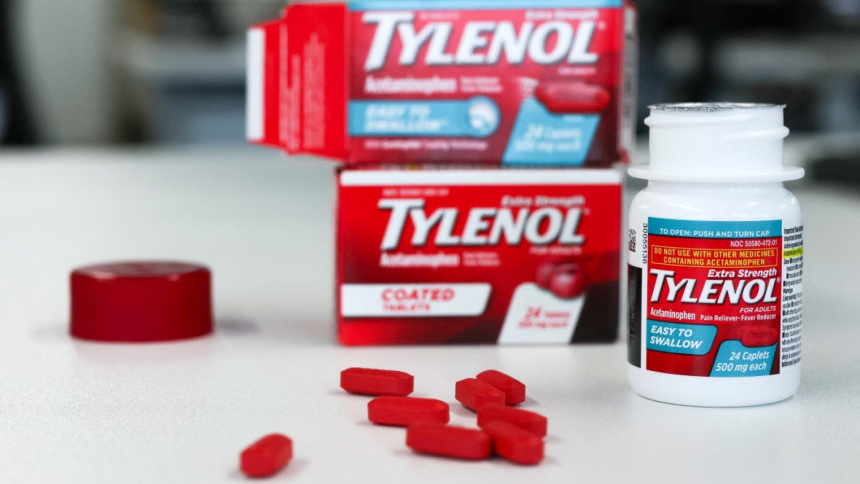

The World Health Organisation (WHO) has firmly rejected claims that Tylenol or vaccines are linked to autism, after recent remarks by U.S. President Donald Trump. On Monday, Trump suggested that pregnant women should avoid Tylenol, citing an unproven link to autism, and called for significant changes to standard childhood vaccination practices.
Medical experts have long maintained that acetaminophen, the active ingredient in Tylenol, is among the safest painkillers for use during pregnancy. Addressing these concerns, WHO spokesman Tarik Jasarevic acknowledged that a few observational studies had hinted at a possible association between prenatal exposure to acetaminophen and autism.
However, he emphasized that the evidence remains inconsistent and that subsequent research has not found any reliable connection. “If the link were strong, it would likely have been consistently observed across multiple studies,” Jasarevic explained, cautioning against drawing premature or misleading conclusions.
Trump also cast doubt on the safety of routine vaccinations, including the widely used MMR (measles, mumps, rubella) shot, echoing arguments long circulated by the anti-vaccine movement.
He further implied that aluminum, a common vaccine component, should be eliminated, despite extensive scientific evidence confirming its safety.
The WHO was clear in its response: “Vaccines do not cause autism.” Jasarevic underscored that childhood immunization programs, guided by WHO, have been implemented worldwide and have saved an estimated 154 million lives over the past 50 years. These schedules, which continue to evolve based on the latest science, now protect against 30 infectious diseases across all age groups.
He also warned that disrupting or altering vaccination schedules without evidence significantly raises the risk of disease outbreaks. “Each missed dose increases the chances of contracting a life-threatening infection,” he said, stressing that both individuals and entire communities are placed at risk when immunization coverage is undermined.
This reaffirmation from WHO comes at a critical time, as misinformation about vaccines and medications continues to spread, threatening global health progress.
