

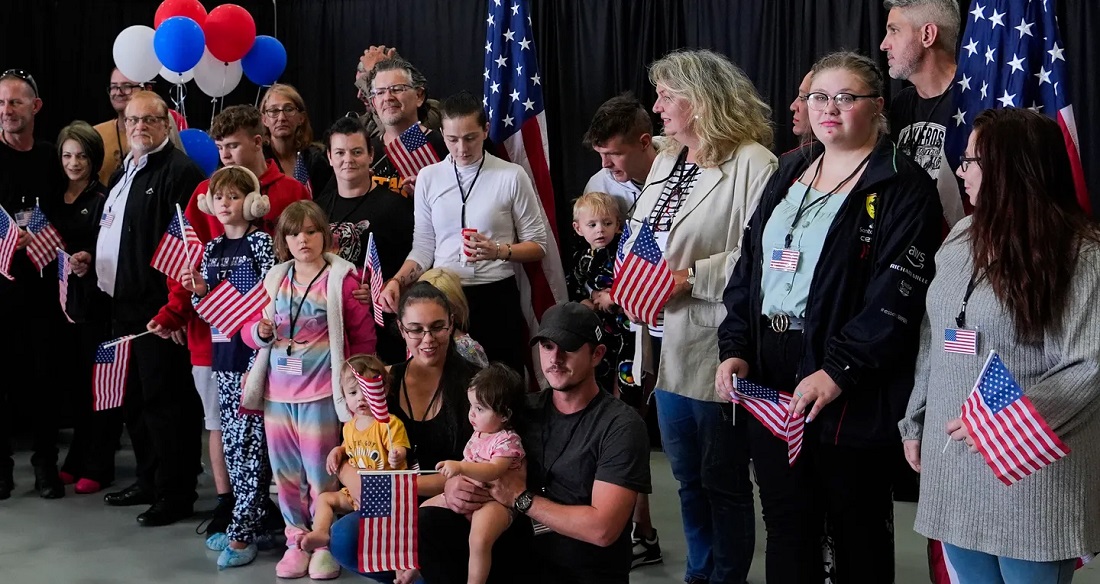

A group of 59 white South Africans has arrived in the United States for resettlement after former President Donald Trump granted them refugee status, citing what he described as a “genocide” in South Africa—an assertion widely disputed by experts and South African officials.
Greeting the group at Dulles International Airport in Virginia, U.S. Deputy Secretary of State Chris Landau welcomed the arrivals from Johannesburg. “Welcome to the land of the free,” he said, as some of the newcomers waved small American flags. “We’re sending a clear message that the United States rejects the egregious persecution of people based on race in South Africa.”
Speaking earlier at the White House, Trump described the situation for white farmers in South Africa as “terrible” and repeated controversial claims of systematic violence against Afrikaners. “It’s a terrible situation taking place,” he said. “So we’ve essentially extended citizenship to those people to escape from that violence and come here.”
Trump added that while the group happens to be white, “whether they’re white or black makes no difference to me.” The decision stands in stark contrast to his administration’s broader refugee policy, which sharply curtailed refugee admissions during his time in office.
South African President Cyril Ramaphosa has firmly rejected Trump’s claims, stating that there is no systematic persecution of white South Africans. “What he’s being told is simply not true,” Ramaphosa said during a forum in Abidjan. “A refugee is someone fleeing political, religious, or economic persecution—they don’t fit that bill.”
Ramaphosa emphasized that South Africa, unlike many post-colonial nations, never expelled its white population. “We’re the only country on the continent where the colonizers came to stay, and we have never driven them out,” he said.
South African Foreign Minister Ronald Lamola also dismissed the narrative of racial persecution against white South Africans. Citing official statistics, Lamola pointed out that the majority of violent crime victims in South Africa are young Black men in urban centers. “Crime affects everyone in South Africa, regardless of race or gender,” he stated.
Despite Pretoria’s firm denials, Trump’s move has reignited debate over race, immigration policy, and the use of refugee status as a political tool. The resettlement of the Afrikaners under this exceptional policy marks a highly unusual case in U.S. refugee admissions history.
