

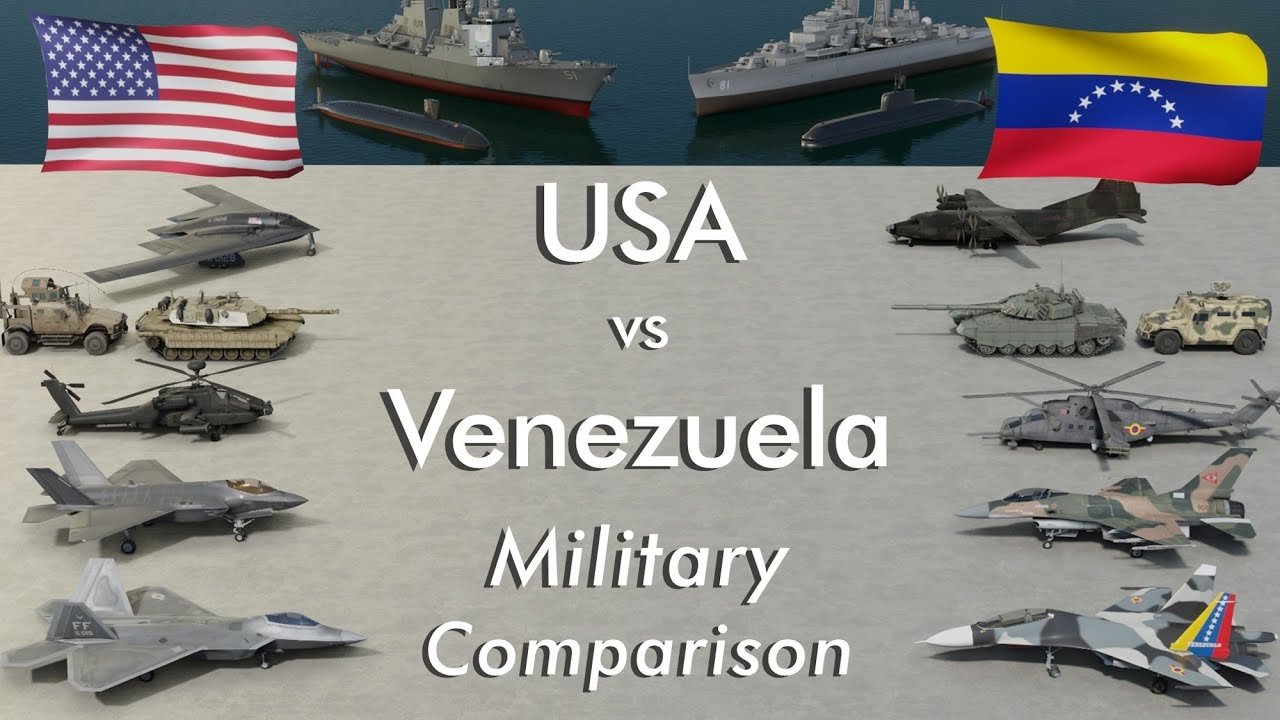

Venezuela’s military strength has come under sharp global focus after reports of alleged United States air activity near Caracas on January 3, 2025. Videos circulating online have shown what appear to be air strikes and explosions near military installations in the Venezuelan capital. While official confirmation remains limited, the situation has renewed debate over how Venezuela’s armed forces compare with the overwhelming military power of the United States.
According to the Global Firepower (GFP) Index 2025, Venezuela ranks 50th out of 145 countries in overall military strength. The United States holds the number one position, maintaining its status as the world’s strongest military. The index evaluates more than 60 indicators, including manpower, equipment numbers, finances, logistics, and geography.
Manpower and Ground Strength
Venezuela has a population of around 31.25 million, giving it a sizable pool of potential military manpower. About 15.6 million people are considered available for service, while 12.8 million are deemed fit for duty.
The country maintains around 109,000 active military personnel, ranking 43rd globally. Reserve forces are relatively small at 8,000, placing Venezuela much lower in this category. However, the country compensates through strong paramilitary forces, estimated at 220,000, many of whom are part of government-aligned militias.
In total, Venezuela’s military-related manpower is estimated at 337,000 personnel. The army is the largest branch, with about 115,000 troops, followed by the navy and air force. In a prolonged conflict, analysts estimate Venezuela could mobilise over 2.8 million people, largely for defensive roles.
Air and Naval Capabilities
Venezuela’s air force remains one of its weaker components. The country operates about 229 aircraft in total. This includes 30 fighter and interceptor aircraft and 88 helicopters, with only 10 attack helicopters. Notably, Venezuela has no dedicated ground-attack aircraft, which significantly limits its strike capabilities.
Transport aircraft form a stronger area, with 49 fixed-wing transport planes, helping with logistics and troop movement. However, limited access to spare parts and ageing platforms reduce operational readiness.
Naval power is also modest. Venezuela operates 34 naval assets, including one frigate, one diesel-electric submarine, and 25 patrol vessels. The navy lacks aircraft carriers, destroyers, and advanced surface combat ships, restricting its ability to project power beyond coastal waters.
Resources, Budget, and Comparison With the US
Venezuela holds the world’s largest proven oil reserves, estimated at 304 billion barrels. It also possesses large natural gas reserves, ranking among the top ten globally. These resources provide fuel self-sufficiency but offer limited military advantage due to sanctions and infrastructure challenges.
The country’s defence budget stands at roughly $4.1 billion, placing it well below major military powers. High external debt and limited foreign reserves further constrain spending.
By contrast, the United States fields more than 1.3 million active-duty personnel, backed by vast reserves. It operates thousands of advanced aircraft, over 5,000 tanks, and the world’s most powerful navy, including 11 aircraft carriers. The US defence budget exceeds $850 billion annually, enabling unmatched global reach.
Experts say Venezuela’s military is regionally significant but primarily defensive. It lacks the technology, funding, and scale needed to challenge US firepower directly.
