

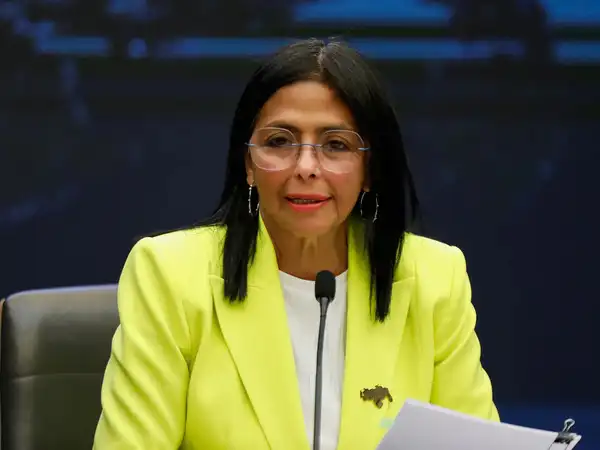

Venezuela entered a period of deep political uncertainty on Saturday after its Supreme Court ordered Vice President Delcy Rodríguez to assume interim presidential powers. The decision followed the detention of President Nicolás Maduro during a US-led operation and his subsequent transfer to New York.
The ruling was issued by the Constitutional Chamber of Venezuela’s Supreme Court. It stated that Rodríguez would take charge to ensure continuity of governance. The court cited the “forced absence” of the president as the legal basis for its decision.
Supreme Court Orders Temporary Transfer of Power
According to the court ruling, Delcy Rodríguez will assume the duties of president to safeguard state administration and national defense. The judges emphasized the need to maintain institutional stability during the crisis.
The court also announced further deliberations. These discussions aim to determine the legal framework needed to preserve sovereignty and state continuity. Officials said the move was necessary to avoid a power vacuum.
Rodríguez later appeared on state television alongside senior officials. She condemned Maduro’s detention and described it as a kidnapping. She reaffirmed that Maduro remains Venezuela’s legitimate president, despite the court’s order assigning her interim authority.
Security remained tight in Caracas. Soldiers were deployed in some areas. Small pro-government gatherings were reported, while daily life continued largely uninterrupted.
Maduro Arrives in New York After US Detention
Meanwhile, multiple media outlets reported that Maduro arrived in the United States on Saturday. He was flown to upstate New York after being detained overnight by US forces.
Video footage showed an aircraft landing at Stewart International Airport. US personnel, including FBI agents, boarded the plane after landing. American television networks identified Maduro among those disembarking.
US officials later confirmed his arrival. A heavy security convoy was seen entering the Metropolitan Detention Center in Brooklyn. Maduro is expected to appear in Manhattan federal court on Monday.
US prosecutors have charged Maduro with several offenses. These include narco-terrorism conspiracy and drug trafficking. His wife, Cilia Flores, also faces charges related to cocaine importation.
Trump Announces Temporary US Control of Venezuela
US President Donald Trump announced that the United States would place Venezuela under temporary American control. Speaking in Florida, he said this would continue until a “safe and proper transition” could be achieved.
Trump claimed the move was in Venezuela’s best interest. He said US officials would oversee the process. He did not name a future Venezuelan leader or explain how control would be exercised on the ground.
Trump said he was open to deploying US troops. He added that the United States was not afraid of “boots on the ground.” Legal experts in the US questioned the legality of seizing a foreign head of state.
International reaction was swift. China and Russia criticized the move. Mexico condemned the intervention, while Brazil called it an unacceptable violation. Argentina welcomed what it described as Venezuela’s new freedom.
Regional Impact and Domestic Political Risks
The sudden removal of Maduro has raised fears of a power vacuum. Venezuela borders several countries, including Colombia and Brazil. Analysts warn that instability could spill across the region.
Trump’s comments revived memories of past US interventions in Latin America. Comparisons were also drawn to Iraq and Afghanistan. Critics questioned claims that Venezuela’s oil would cover the cost of US involvement.
At home, Trump faces political risks. Democrats argue voters are more concerned about inflation than foreign interventions. Some Republican allies also voiced discomfort, warning the move contradicts “America First” promises.
As Venezuela navigates this unprecedented moment, uncertainty remains high. The actions taken in the coming days could shape the country’s future and regional stability.
