

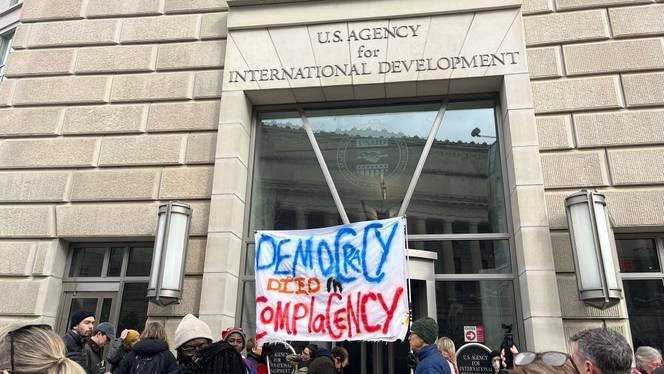

Democratic lawmakers and hundreds of protesters gathered outside the USAID headquarters in Washington, DC, on Monday, condemning the controversial efforts to shut down the U.S. foreign aid agency. The protest intensified after Elon Musk, the world’s wealthiest man, gained control over the agency, and Senator Marco Rubio was appointed acting administrator. Employees at the U.S. Agency for International Development (USAID) found themselves locked out of their offices, with many uncertain whether they’d ever return.
Among the protesters were several Democratic senators and congresspeople, including Chris Van Hollen, Ilhan Omar, Jim McGovern, Chris Murphy, and Jamie Raskin. They criticized the perceived power grab, with Representative Omar sharing her personal connection to USAID’s humanitarian efforts, having relied on its assistance as a refugee.
“USAID is key to U.S. soft power,” she told TRT World. Representative McGovern also spoke passionately, emphasizing how the agency’s work in global health, rebuilding, and disaster relief helps build goodwill for the U.S. globally.
Senator Van Hollen added, “Billionaires who have not been elected cannot tell American employees they cannot access the building they work at.”
Musk’s Controversial Announcement
The protests were sparked by a revelation from Musk during a live discussion on his social media platform, X. He claimed that former President Trump was set to shut down USAID. “I actually checked with him a few times,” Musk said. “I said, ‘Are you sure?’ He replied, ‘Yes. We’re shutting it down.’” While Trump didn’t confirm Musk’s statement directly, his recent comments painted USAID as a “bloated bureaucracy run by radical lunatics,” further intensifying concerns.
In recent days, senior USAID officials have been placed on leave, and contractors fired. On Saturday, the agency’s two top security chiefs were placed on administrative leave after refusing to allow access to a team sent by Musk’s Department of Government Efficiency (DOGE). Many USAID contractors around the world were left stranded and unable to access official systems.
Musk and Trump’s Push for Change
Musk, with Trump’s backing, has focused on eliminating what he views as wasteful government spending, with USAID being a primary target due to its massive $38.1 billion budget. The agency has long been a key instrument of U.S. foreign policy, providing humanitarian aid and development assistance across more than 100 countries, especially in Eurasia, sub-Saharan Africa, and Europe. But the suspension of foreign aid last month left humanitarian groups scrambling, and speculation has grown about whether USAID will be restructured or dissolved.
Possible Future of USAID
The prevailing theory in Washington is that USAID could be folded into the State Department, reducing its budget and scope, if it survives at all. Rubio’s appointment as acting administrator signals a potential push to integrate USAID more tightly under State Department control. The State Department later issued a statement, arguing that USAID had strayed from its original mission and that significant portions of its funding no longer aligned with U.S. national interests.
Musk’s Harsh Criticism
Musk’s public comments about USAID have been harsh. He referred to the agency as a “criminal organization” and called for its demise, framing his actions as a necessary disruption. While supporters of Musk’s approach argue that USAID is an inefficient bureaucracy that wastes billions, others are concerned that such drastic changes may harm U.S. influence abroad.
However, any attempt to dismantle USAID would face significant legal and political hurdles. Established by Congress through the Foreign Assistance Act of 1961 and later solidified by law in 1998, USAID is an independent executive agency. Shutting it down would likely require Congressional approval and could face legal challenges.
Employee and Lawmaker Concerns
USAID employees, however, argue that the current changes are not about reform but dismantling a vital agency. A senior USAID official emphasized that the agency understands how to work in fragile environments, providing much-needed assistance worldwide.
Democratic lawmakers, including the Senate Foreign Relations Committee, have demanded an immediate review of Musk’s actions, calling them an “unauthorized breach” of USAID operations. Concerns have also been raised about national security, especially regarding the potential access to sensitive or classified information.
Looking Forward
As protests continued outside USAID’s headquarters, Congressman Jamie Raskin raised the stakes of the moment, asking, “What kind of America are we becoming?” The future of USAID remains uncertain, with many questioning whether Trump and Musk’s vision for reshaping the agency is a step toward more effective diplomacy or a dangerous move toward undermining U.S. soft power.
