


In another embarrassing blow, India has been downgraded from ‘Free’ to Partially Free’ in the annual report published by Freedom House, a Washington-based pro-democracy think tank and watchdog.
Published this week, the latest survey marks the 4th consecutive year of democratic backsliding in India. According to the report, India, under Prime Minister Narendra Modi, appears to be inching closer to authoritarianism.
“Rather than serving as a champion of democratic practice and a counterweight to authoritarian influence from countries such as China, Modi and his party are tragically driving India itself toward authoritarianism,” the democracy research institute said in its annual assessment.
Political rights and civil liberties, the authors wrote, have eroded in India since Modi became prime minister in 2014. The deterioration in political rights and civil liberties, the report said, had accelerated after the Indian prime minister’s re-election in 2019.
The US government funded NGO which has been a vigorous proponent of democratic values for almost eight decades, assigned an overall score of 67 to India in its annual Freedom in the World report. The decline from last year’s status, the democracy advocacy group noted, was driven by several factors, including legislation and policies that undermine the political rights of Muslims, increased government pressure on human rights organizations, and rising intimidation of academics and journalists in the country.
“I’m not surprised at all. Since Modi’s election India has become a more regulated society. One way of judging it is how dissenters and journalists are being treated. In the last couple of years India has become a very dangerous place for journalists, particularly those who criticize Modi or his Hindu nationalist Bharatiya Janata Party (BJP),” said Dr. Talat Wizarat, a noted scholar of International Relations.
“The erosion of rights happened gradually, but the free fall probably became difficult to control after Modi’s re-election in 2019,” said the former chairperson of Department of International Relations at University of Karachi.
According to the Washington-based research institute, India has witnessed a 9-point decline since 2005. This year’s report also raises several questions about the Indian judiciary’s role. Citing the recent acquittal of BJP leaders who were credibly accused of orchestrating the demolition of the Babri Mosque in 1992, the report said judicial independence had also come under strain since Modi’s re-election.
Quoting another case from last year, the authors mentioned that a judge was transferred to a less desirable position after he issued rulings that criticized Delhi police for their failure to address communal violence and related hate speech by BJP politicians.
Referring to the Indian government’s actions against members of the Tablighi Jamaat, the advocacy group said Muslims were scapegoated by the BJP government as potential spreaders of the coronavirus and subsequently exposed to attacks by vigilante mobs.
Freedom House also highlighted laws against religious conversions implemented in BJP-ruled states. “Under Modi, India appears to be elevating narrow Hindu nationalist interests at the expense of its founding values of inclusion and equal rights for all,” the report said.
An increasing number of Hindutsva activists claim that Hindu women are being forcibly converted by Muslim men through marriage. The theory has been labeled as ‘love jhad’. Such conspiracies, the report explained, are being used to enact laws that prevent interfaith marriages in India.
In its annual report, Freedom House assigns a grade to each country on 25 different indicators that measure the health of a given country’s democracy. The overall score allows the Washington-based pro-democracy watchdog to rank countries as “Free”, “Partly Free” or “Not Free”.
View from Washington
At the Woodrow Wilson Center, Michael Kugelman believes any criticism from a Biden administration would be relatively muted, given that its core focus remains on India’s strategic value.
“The Biden administration will monitor concerns about democracy and rights in India more closely than did the Trump administration. But the Biden administration, like all previous US governments since the early 1990s and especially the early 2000s, views India as a strategic partner,” explained Michael Kugelman, Deputy Director for the South Asia Program. “At the end of the day, it is interests and not values that drive US-India partnership,” he cautioned.
While the US president has spoken openly about defending human rights, the subject was ignored during the telephone call to the Indian prime minister last month. Both Biden and Modi discussed the rise of China’s influence and ways to increase cooperation.
“The US administration won’t risk antagonizing New Delhi by calling it out extensively on democracy issues. Most criticism and concerns will be conveyed privately. If there is public commentary, it will likely be measured,” said Kugelman by email from Washington.
Referring to New Delhi’s tendency to suspend the internet, the South Asia expert said: “If there’s one issue that will galvanize the Biden administration, it’s internet bans.”
With 8,927 hours of controlled bandwidth access, India has restricted internet use more than any other country, according to a recent report published by Bloomberg.
“Biden has expressed particular concern about technology being used undemocratically, and New Delhi’s tendency to suspend the internet will get the attention of his administration,” said Kugelman.
When asked what it would take for New Delhi to change its current course, Kugelman said: “If global financiers begin to worry that democratic backsliding and instability in India are making the country a less friendly investment environment, then that could prompt India to change.” “I do think India is attentive to the perceptions of foreign investors,” he added.
A big driver of the future of democracy in India, Kugelman said, will be the direction of New Delhi’s Hindu nationalist agenda, which has been pursued aggressively in recent years.
He advised policy makers in Washington to continue their criticism of Modi’s policies in a respectful manner. “There’s nothing wrong with expressing concerns to India about democracy and rights, and especially if the administration acknowledges concerns about democracy in the US as well.”
The democracy-focused messaging of US-India relations, Kugelman said, will sound a lot more credible if each side is willing to acknowledge its democracy challenges at home.
Indian Held Kashmir
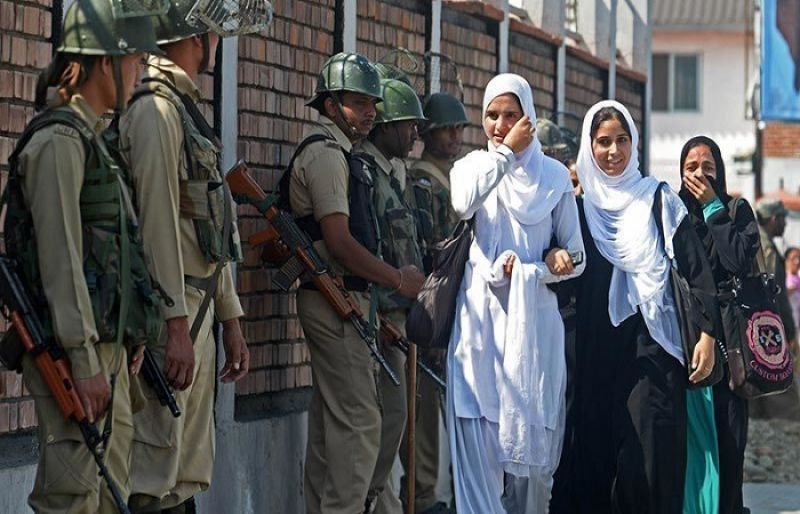
The Freedom in the World report notes that Kashmir’s status declined to ‘Not Free’ due to the Indian government’s abrupt revocation of the territory’s autonomy.
According to the US government-funded research and advocacy group, Indian security forces are frequently accused of human rights violations in the occupied territory, but few are punished.
Since being downgraded from state to union territory, Kashmir has been governed by centrally appointed administrators. Communications, internet access, and freedom of assembly were severely restricted following the Indian government’s actions two years ago.
Freedom House also pointed to the forced abduction of thousands of Kashmiris—including politicians, students, journalists, and academics— who were detained, without any charge or notice.
“Kashmiri’s have suffered more under Modi than any Indian government. The valley has been transformed into the largest jail in the world,” said Dr. Talat Wizarat, a Karachi-based expert who has been following the development very closely since 2019.
“India is moving towards a totalitarian status. What is important is that the world is now beginning to notice the atrocities,” added Dr Wizarat.
Dr Wizarat cautioned that the policy of appeasement carries a very heavy cost for innocent people and for the entire world. “If appeasement goes on unchecked, the power that is being appeased becomes more confident.”
Such policies, Dr. Wizarat warned, have caused war. She urged the global community to take appropriate action against Indian government’s policies.
