

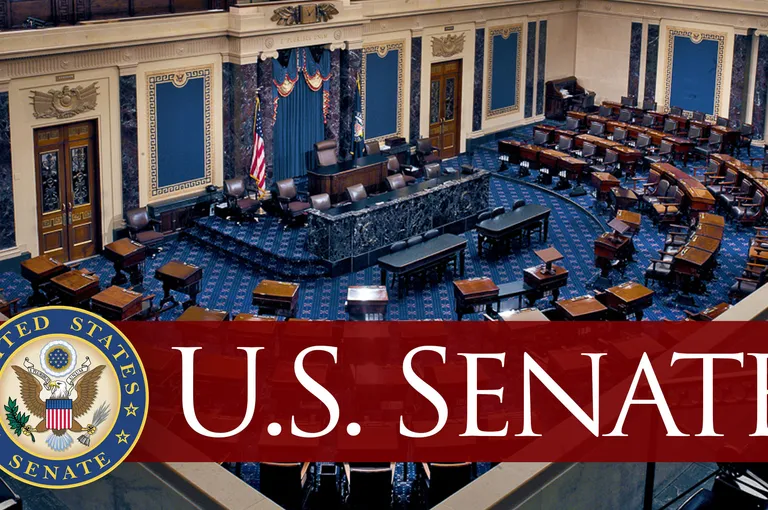

The United States Senate has taken a significant step toward curbing President Donald Trump’s authority to launch further military action against Venezuela without congressional approval. On Thursday, senators voted to advance a war powers resolution that would require the president to seek authorisation from Congress before engaging in additional military operations.
The procedural vote passed with a narrow margin of 52 to 47. Five Republican senators broke ranks and joined all Democrats to move the resolution forward. One Republican senator did not cast a vote. The decision allows the measure to proceed to further debate in the full Senate, marking a notable shift in momentum on Capitol Hill.
The vote comes amid heightened tensions following the recent capture of Venezuelan President Nicolas Maduro by U.S. forces during a dramatic operation in Caracas. That event has intensified concerns among lawmakers about executive overreach and the lack of transparency with Congress.
Senate Dynamics Shift After Maduro’s Arrest
Until now, similar efforts to limit Trump’s war powers had repeatedly failed. Last year, Republicans blocked two comparable resolutions as the administration increased pressure on Venezuela through naval actions and seizures of oil shipments.
The most recent failed vote in November was extremely close. It was blocked 51 to 49, shortly after senior Trump advisers assured lawmakers that the administration had no plans to change Venezuela’s government or conduct strikes on its territory.
Maduro’s capture has changed the political atmosphere. Several lawmakers now claim Congress was misled. Some Democrats have voiced their criticism openly, while concerns have also grown quietly among Republicans.
Senator Rand Paul of Kentucky, a Republican co-sponsoring the resolution, said the vote reflected changing attitudes. Standing alongside Democratic Senator Tim Kaine of Virginia, Paul said more Republicans were reconsidering their earlier positions.
He noted that at least two Republican senators who had previously opposed the measure were now expressing doubts about unchecked military authority. Both Paul and Kaine serve on the powerful Senate Foreign Relations Committee.
The Republicans who supported advancing the resolution were Rand Paul, Susan Collins of Maine, Josh Hawley of Missouri, Lisa Murkowski of Alaska, and Todd Young of Indiana. Despite this defection, Republicans still hold a slim 53-47 majority in the Senate.
Constitutional Concerns and Roadblocks Ahead
Supporters of the resolution argue that the U.S. Constitution clearly assigns the power to declare war to Congress. They say presidents have increasingly bypassed lawmakers, weakening democratic oversight.
Thursday’s vote is seen as a symbolic victory for lawmakers pushing to reassert congressional authority. However, passing the resolution into law remains an uphill battle.
Even if the Senate approves the measure, it must still pass the Republican-led House of Representatives. It would then face a likely presidential veto. Overriding that veto would require a two-thirds majority in both chambers, a difficult threshold to reach.
Backers of the resolution admit the odds are long. Still, they believe concerns about prolonged military involvement and rising costs could influence more lawmakers. The United States is already dealing with large budget deficits.
President Trump recently announced his desire to increase military spending to $1.5 trillion. That statement has further alarmed lawmakers worried about expanding overseas commitments.
Senator Kaine pointed out that U.S. forces have been striking Venezuelan boats for months. He also referenced Trump’s comments about potentially “running” Venezuela and ongoing oil seizures. According to Kaine, these actions go beyond a limited arrest mission.
Opposition Defends Presidential Authority
Opponents of the resolution insist that Maduro’s capture was a law enforcement operation, not a war. They argue that the president has the constitutional authority as commander-in-chief to conduct limited military actions when national security is at stake.
Maduro is expected to face trial in the United States on drug trafficking and weapons charges. He has denied all allegations.
Senator Jim Risch of Idaho, the Republican chair of the Senate Foreign Relations Committee, criticised the resolution sharply. He said it was designed to embarrass the president rather than address an active conflict. According to Risch, the measure cannot stop an action that is not currently underway.
As debate continues, the resolution highlights growing divisions in Washington over war powers, executive authority, and the future of U.S. involvement in Venezuela.
