

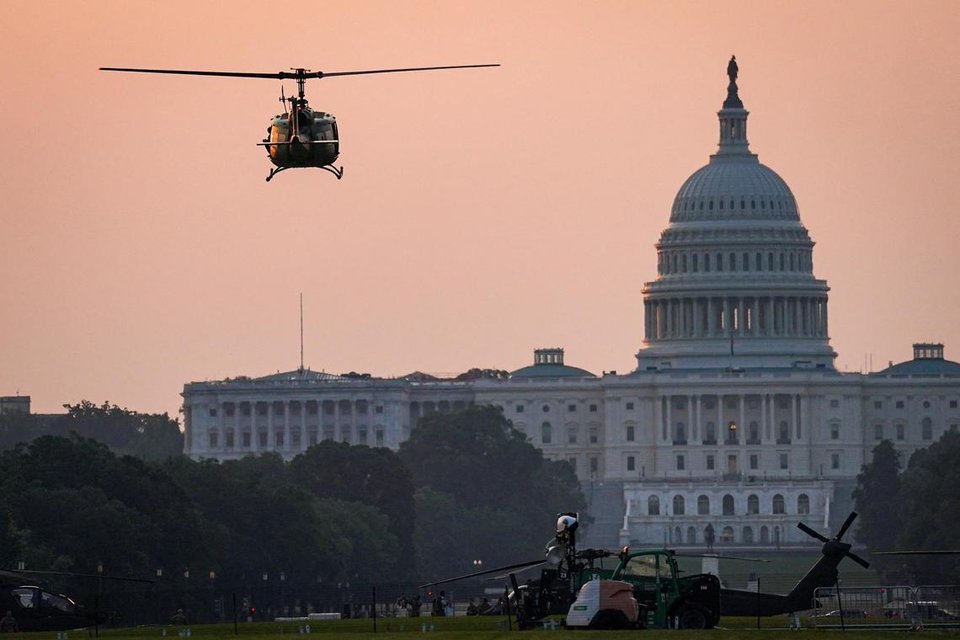

US Lawmakers
In the wake of the United States’ unprecedented airstrikes on Iranian nuclear facilities early Sunday morning, members of the US Congress issued sharply divergent reactions, highlighting a growing rift across party lines regarding the legality, strategy, and implications of the attack.
While many Republicans voiced strong support for the military operation, several Democrats and some conservative Republicans raised serious constitutional and strategic concerns.
The strikes, which targeted Iran’s key nuclear installations in Fordow, Natanz, and Isfahan, have sparked debate over whether President Donald Trump overstepped executive authority by bypassing congressional approval for military action.
Senator Roger Wicker, a Republican from Mississippi and Chairman of the Senate Armed Services Committee, praised the strikes as necessary but warned of looming challenges. “This operation was successful, but the United States now faces very serious choices ahead,” Wicker stated.
Senator Jim Risch, Republican Chairman of the Senate Foreign Relations Committee, echoed the sentiment, declaring: “This war is Israel’s war, not our war, but Israel is one of our strongest allies. This is not the start of a forever war. There will not be American boots on the ground in Iran.”
However, constitutional concerns were raised by conservative Republican Representative Thomas Massie of Kentucky, who emphasized that only Congress holds the power to declare war. “This is not constitutional,” Massie wrote on social media.
House Speaker Mike Johnson, a Republican from Louisiana, defended President Trump’s decision, stating that Iran had been given multiple chances to agree to nuclear disarmament. “The president’s decisive action prevents the world’s largest state sponsor of terrorism, which chants ‘Death to America,’ from obtaining the most lethal weapon on the planet,” Johnson said.
In contrast, Democratic leaders responded with fierce criticism. House Democratic Leader Hakeem Jeffries accused Trump of misleading the country and bypassing congressional authority. “President Trump misled the nation about his intentions, failed to seek congressional authorisation, and now risks dragging the United States into a potentially disastrous Middle Eastern war,” he said.
Representative Alexandria Ocasio-Cortez of New York called the airstrikes a “grave violation” of the Constitution and war powers. “This is absolutely grounds for impeachment,” she added.
Democratic Senator Tim Kaine of Virginia, a long-time critic of unauthorized military action, also denounced the strikes. “The American public is overwhelmingly opposed to war with Iran. Trump’s decision reflects horrible judgment,” Kaine said.
Representative Rashida Tlaib of Michigan strongly condemned the move, stating: “The American people do not want another forever war. President Trump’s unilateral action is a blatant violation of our Constitution.”
Max Rose, a former Democratic Congressman and current adviser to the progressive veterans’ group “VoteVets,” labelled the strikes as illegal and politically motivated. “This conflict belongs to Trump and the Republicans who have abandoned their responsibilities,” he said.
Despite the polarised reactions, the strikes have ignited a critical debate in Washington about war powers, the role of Congress in authorising military force, and the broader risks of entangling the United States in another prolonged conflict in the Middle East. As regional tensions continue to rise, so too does the scrutiny on President Trump’s decision-making and the administration’s next steps.
