

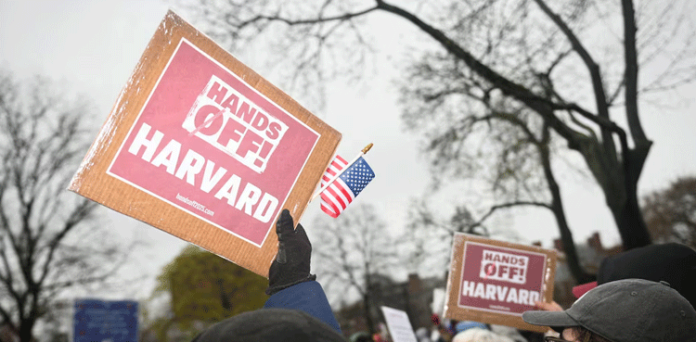

Harvard Research Funding
The United States government has escalated its financial crackdown on Harvard University, announcing the termination of approximately $60 million in federal research grants, citing the university’s alleged failure to curb anti-Semitism and racial discrimination on campus. This decision adds to an already tense standoff between the Trump administration and one of the most prestigious academic institutions in the country.
On Monday, the Department of Health and Human Services (HHS) posted a statement on X (formerly Twitter), confirming the suspension of multiple multi-year grant awards to Harvard. “Due to Harvard University’s continued failure to address anti-Semitic harassment and race discrimination, HHS is terminating multiple multi-year grant awards – totaling approximately $60 million over their full duration,” the statement read. The department emphasized that federal funding must be reserved for institutions that protect the rights and dignity of all students.
This move follows months of mounting pressure on Harvard. The administration has already frozen more than $2.2 billion in federal funding for research and educational purposes.
Earlier this month, Education Secretary Linda McMahon issued a letter accusing the university of failing to uphold standards of academic integrity and inclusion, declaring that Harvard would no longer qualify for federal research funding. “Harvard will cease to be a publicly funded institution and can instead operate as a privately-funded institution, drawing on its colossal endowment and raising money from its large base of wealthy alumni,” McMahon stated.
In response, Harvard has filed a lawsuit challenging the legality of the funding freeze, asserting that the administration’s actions violate the First Amendment and federal protections against presidential interference in educational institutions.
Harvard President Alan Garber recently announced the allocation of $250 million from the university’s endowment to sustain ongoing research projects affected by the federal pullout.
The tension between the Trump administration and Harvard intensified in March, following a wave of pro-Palestinian student demonstrations across top-tier U.S. campuses. These protests condemned Israel’s military actions in Gaza and raised allegations of human rights violations and genocide.
President Trump has repeatedly criticized the demonstrations, labeling them as “illegal” and “anti-Semitic.” Student organizers, however, have insisted that their protests were peaceful and intended to draw attention to the humanitarian crisis in Gaza.
In April, the administration issued a list of directives to Harvard, demanding the overhaul of its disciplinary and diversity frameworks and compliance with an external audit to investigate allegedly anti-Semitic content and programs. Harvard’s refusal to comply with these terms led to the first wave of funding freezes.
The controversy has further fueled conservative critiques of elite universities, which they accuse of advancing liberal ideologies and marginalizing conservative perspectives. As the standoff continues, it underscores the broader debate over academic freedom, free speech, and the role of federal oversight in higher education.
