

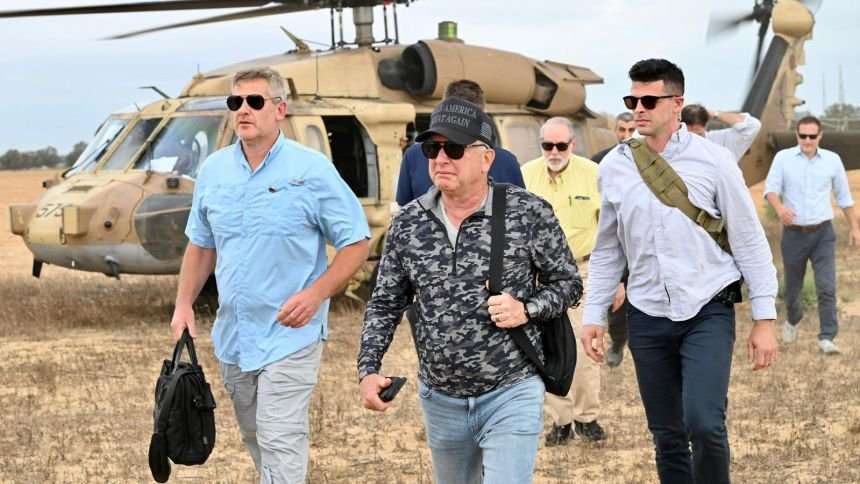

Steve Witkoff, the United States’ special envoy to the Middle East, paid a significant visit to Rafah on Friday, where he toured an American-backed aid distribution center amid worsening humanitarian conditions in Gaza. His visit comes at a time of heightened concern over widespread starvation across the enclave, as international aid agencies and rights groups raise alarms over the spiraling crisis.
Witkoff, joined by US Ambassador to Israel Mike Huckabee, spent nearly five hours on the ground, meeting with aid workers and local officials linked to the Gaza Humanitarian Foundation (GHF).
This organization, formed as an alternative to UN-led aid operations, has become central to American and Israeli efforts to manage humanitarian assistance in Gaza independently of the United Nations. However, the foundation has faced growing criticism for its inability to effectively ease the hunger crisis and for its alleged involvement in recent violence at distribution sites.
Reports suggest that more than 1,000 Palestinians have been killed in recent weeks while trying to collect food, many near GHF-run facilities. Eyewitnesses and video footage indicate that Israeli forces have opened fire on crowds at these distribution points, while others have died in stampedes driven by desperation and food scarcity.
These incidents have drawn condemnation from the UN, which accuses the GHF of undermining neutral humanitarian efforts and failing to establish proper safety protocols.
Following the visit, President Donald Trump addressed the situation, stating that the primary focus of Witkoff’s mission was to ensure that food reaches those in need. “There is real starvation,” Trump said at a press conference in Washington, acknowledging the scale of the crisis and contradicting recent Israeli claims that the humanitarian situation is under control. He noted that Witkoff held “a great meeting” and emphasized the urgency of delivering aid.
Ambassador Huckabee, speaking after the visit, defended the GHF’s role, claiming it delivers food “without interference” and accused Hamas of opposing the initiative because it bypasses the group’s control. Israeli officials have long alleged that UN-led aid was being misappropriated by Hamas, a charge that the GHF initiative was designed to address.
Nevertheless, humanitarian observers remain deeply concerned. The United Nations and several rights organizations argue that the situation in Gaza has reached a breaking point, with malnutrition levels described as catastrophic.
The lack of a coordinated and secure humanitarian corridor has further compounded the crisis, with repeated calls for international action to ensure unimpeded access to essential supplies for Gaza’s 2.2 million residents.
As political divisions deepen and violence around aid distribution sites continues, the effectiveness and legitimacy of the GHF — and broader US and Israeli-led humanitarian strategies — remain in question. Many argue that only a fully neutral, internationally coordinated approach will be capable of addressing the dire needs of the population and preventing further tragedy.
