

The United States has intensified military activity by deploying strategic bombers to a British airbase during the ongoing war involving Iran. Three B-1B Lancer bombers landed at RAF Fairford in the United Kingdom following what is believed to be an American strike mission linked to the conflict.
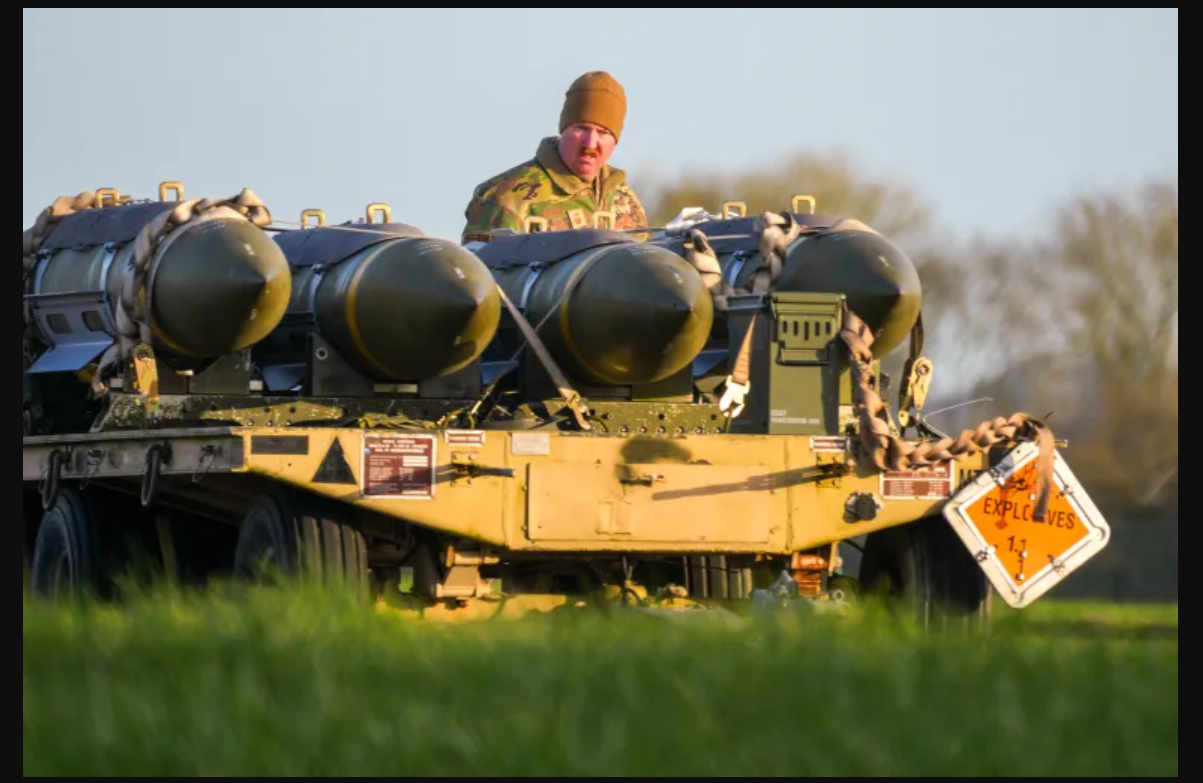
Ground crews were seen preparing additional bunker-busting munitions at the base shortly after the aircraft returned. The activity signals a growing operational role for British facilities in ongoing military operations.
As tensions continue to rise, the development highlights deeper coordination between US and UK defence structures.
Advanced Bombs Prepared for Strategic Missions
Military personnel loaded bunker-busting bombs equipped with Joint Direct Attack Munition (JDAM) guidance kits onto US aircraft.
These kits transform conventional unguided bombs into precision-guided weapons. They add GPS navigation and control systems that allow accurate targeting.
JDAM systems can be attached to several bomb types, including 500-pound, 1,000-pound, and 2,000-pound munitions. The technology can also enhance penetrator bombs designed to strike hardened or underground targets.
Once programmed with coordinates, the bombs guide themselves toward designated targets after release.
However, aircraft must fly closer to targets compared with long-range missile systems.
RAF Fairford’s Growing Strategic Importance
RAF Fairford has increasingly become a key operational hub during the conflict.
Since the war began on February 28, additional US military aircraft have arrived at the base. These deployments include strategic bombers used for long-range missions.
Earlier, UK leadership stated that British bases would not support offensive strikes. However, policy shifted after a drone attack struck a British military installation in Cyprus.
Following that incident, British authorities approved the use of bases for defensive purposes aimed at neutralising missile threats at their origin.
The latest activity suggests a broader operational scope involving precision bombing capabilities.
UK Military Role Expands in Regional Operations
British forces have also participated in defensive operations across the Middle East.
Military units have helped intercept retaliatory drones and missile attacks launched during the conflict. Additionally, the UK deployed extra assets to the eastern Mediterranean to strengthen regional security.
Officials continue to describe these actions as defensive measures designed to protect allied forces and infrastructure.
Nevertheless, increased military coordination reflects deeper involvement in the wider conflict environment.
Capabilities of the B-1B Lancer Bomber
The B-1B Lancer serves as a long-range strategic bomber capable of carrying large conventional payloads.
Its design allows rapid deployment across continents while maintaining significant strike capacity.
When combined with precision-guided munitions, the aircraft can target fortified installations and underground facilities.
Therefore, its deployment signals a focus on high-value strategic targets.
Public Opinion in the United Kingdom Remains Divided
While military cooperation has expanded, public opinion in Britain appears cautious.
Recent opinion surveys indicate limited public support for military action related to the conflict.
Only a small portion of respondents strongly supported US military operations against Iran. Meanwhile, a significantly larger group expressed strong opposition.
Another survey found that many citizens believe the reasons behind the military campaign remain unclear.
These findings highlight growing domestic debate regarding the UK’s involvement.
Strategic Implications of Base Usage
The use of British airbases by US forces demonstrates how international alliances shape modern conflict dynamics. Military infrastructure located far from active battle zones can still play a decisive role in operations.
As a result, logistical hubs like RAF Fairford become central to planning and execution. The deployment also underscores the importance of precision weapon systems in contemporary warfare. Moreover, evolving cooperation between allied nations may influence future strategic decisions.
Conflict Continues to Reshape Regional Security
The ongoing war continues to affect military positioning across Europe and the Middle East. Allied forces remain focused on deterrence, defence coordination, and operational readiness.
Meanwhile, diplomatic discussions continue alongside military developments.
As the situation evolves, the role of overseas bases and advanced weapons systems will likely remain central to strategic planning.

