

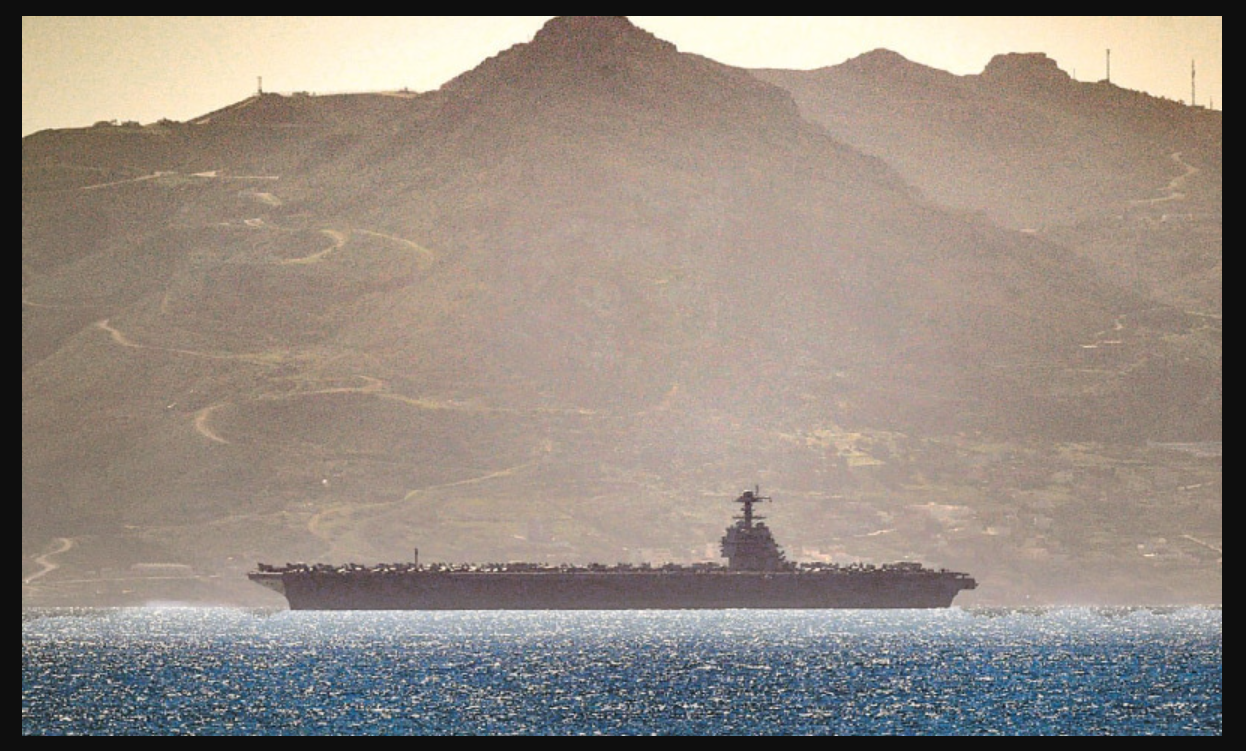

The USS Gerald R. Ford entered the Mediterranean Sea as regional tensions intensified. The deployment followed orders from Donald J. Trump amid growing uncertainty over Iran.
The aircraft carrier transited the Strait of Gibraltar, linking the Atlantic Ocean and the Mediterranean. Consequently, its arrival signals a major expansion of US naval presence in the region.
Trump previously deployed another carrier to the Middle East. However, this latest movement significantly increases operational capability.
US Considers Possible Action Against Iran
President Trump stated that he is considering a limited strike on Iran if negotiations fail. These negotiations aim to replace the nuclear deal that he withdrew from during his first term.
Although no final decision has been announced, military positioning has accelerated. Therefore, the deployment appears designed to enhance leverage during diplomatic talks.
At the same time, Trump indicated that he prefers a meaningful agreement. Yet, he warned that alternatives remain under review.
Rising Number of US Warships in the Region
The United States currently operates 13 warships in the Middle East. These include the aircraft carrier USS Abraham Lincoln, nine destroyers, and three littoral combat ships.
The USS Gerald R. Ford travels with three guided-missile destroyers. When fully positioned, the total number of US warships in the region will rise to 17.
It is rare for two aircraft carriers to operate in the Middle East simultaneously. Consequently, this dual-carrier presence underscores heightened readiness.
Both carriers host thousands of sailors and dozens of advanced warplanes. Therefore, they provide substantial air power and rapid response capability.
Expanded Air and Missile Defenses
Beyond carrier-based aircraft, the United States has deployed additional warplanes to the region. These reportedly include F-22 Raptor and F-35 Lightning stealth fighters.
Moreover, F-15 and F-16 aircraft support broader air superiority objectives. Aerial refueling tankers such as the KC-135 enhance operational range.
In addition, land-based air defense systems have been strengthened. Guided-missile destroyers further provide maritime air defense coverage.
US Military Footprint on Regional Bases
Although ground forces are not expected to conduct offensive operations, the United States maintains tens of thousands of personnel at regional bases. These forces support logistics, intelligence, and defensive roles.
Therefore, the buildup reflects a comprehensive military posture rather than a single deployment.
Strategic Implications
The arrival of the USS Gerald R. Ford marks a significant moment in regional security dynamics. While diplomatic channels remain open, military readiness has clearly intensified.
As negotiations continue, the balance between deterrence and diplomacy will shape developments. Consequently, the Mediterranean deployment highlights Washington’s determination to maintain strategic leverage in a volatile region.
