

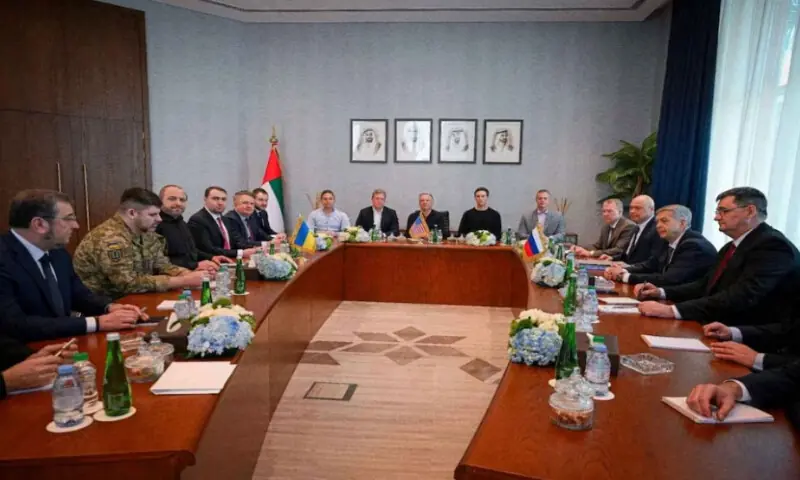

Talks in Abu Dhabi Conclude Without Agreement
Ukraine and Russia ended a second round of U.S.-brokered peace talks in Abu Dhabi on Saturday without reaching any agreement. The discussions took place over two days. They were held amid continued fighting and rising civilian suffering.
Both sides confirmed that no deal was signed. However, Moscow and Kyiv said they remain open to further dialogue. Ukrainian President Volodymyr Zelensky said the talks focused on possible frameworks to end the war.
He said all delegations agreed to report back to their leaderships. Each side will review the details internally. Zelensky added that follow-up meetings could happen as early as next week.
A spokesperson for the UAE government said the talks included rare face-to-face engagement. Russian and Ukrainian representatives discussed unresolved elements of Washington’s proposed peace framework. Confidence-building measures were also explored.
The meetings were described as constructive. Yet no concrete progress was announced. Ukrainian negotiator Rustem Umerov’s office confirmed that the talks concluded in the late afternoon local time.
Saturday was expected to be the final day of the trilateral meeting. Zelensky earlier described it as the first of its kind under U.S. mediation.
Russian Airstrikes Overshadow Diplomatic Efforts
The talks were overshadowed by a massive Russian air assault on Ukraine overnight. Hundreds of drones and missiles struck cities across the country. Energy infrastructure was again a primary target.
Ukraine’s air force said Russia launched 375 drones and 21 missiles. The barrage knocked out electricity and heating for more than one million people. Temperatures were below freezing in many regions.
Kyiv and Kharkiv were among the hardest-hit cities. At least one person was killed. More than 30 others were injured. Power and heating outages left families struggling to stay warm.
Foreign Minister Andrii Sybiha accused Russian President Vladimir Putin of acting cynically. He said the attacks showed Russia was not serious about peace.
“His missiles hit not only our people, but also the negotiation table,” Sybiha wrote on social media.
Kyiv had already suffered two large-scale overnight attacks since the start of the year. Saturday’s bombardment further strained emergency services and repair crews.
Ukraine’s deputy prime minister said around 800,000 people in Kyiv alone were left without power. Many buildings had only recently regained heating from previous strikes.
Key Sticking Points Still Divide Both Sides
Deep disagreements remain at the heart of the negotiations. Russia continues to demand that Ukraine surrender full control of the eastern Donbas region. This includes Donetsk and Luhansk.
The Kremlin has not softened its position. It insists Ukraine give up the remaining 20 percent of Donetsk still under Kyiv’s control. Most of the international community recognises the region as Ukrainian territory.
President Zelensky has repeatedly rejected territorial concessions. He says Ukraine will not give up land Russia failed to capture during four years of war. Public opinion in Ukraine strongly supports his stance.
U.S. peace envoy Steve Witkoff said earlier this week that progress had been made. He claimed only one major sticking point remained. Russian officials, however, have expressed scepticism.
Kyiv also faces pressure from Washington to show flexibility. The Trump administration is pushing for concessions to end the conflict.
Zelensky said the talks included discussions on security guarantees and formalising any future agreement. He stressed that stronger air defence support is urgently needed.
He added that Russia’s overnight strikes proved the importance of fully implementing defence commitments discussed with U.S. President Donald Trump in Davos.
Despite diplomatic efforts, the war continues. Russia says it prefers a negotiated solution. But it will pursue its goals militarily until an agreement is reached.
