

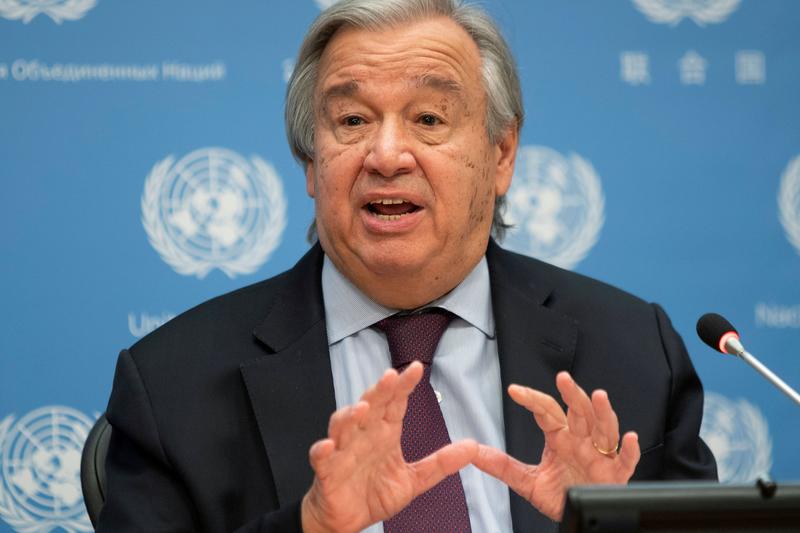

UN Secretary-General António Guterres on Sunday warned that the U.S. airstrikes on Iran’s nuclear facilities represent a dangerous escalation, urging the international community to step back from what he described as a “perilous turn” in the Middle East.
Speaking before a special session of the 15-member UN Security Council, Guterres called for an immediate ceasefire and a return to “serious, sustained negotiations,” stressing that the region cannot afford another spiral of violence.
“The people of the region cannot endure another cycle of destruction,” Guterres said. “And yet, we now risk descending into a rathole of retaliation after retaliation.”
The Council convened in response to recent U.S. airstrikes targeting Iran’s nuclear sites. Russia, China, and Pakistan have jointly proposed a resolution demanding an immediate and unconditional ceasefire. Diplomats confirmed that a draft text has been circulated among Council members, but it remains unclear if a vote will take place imminently.
Guterres emphasized the urgent need for diplomacy to prevail and called for the protection of civilians and assurance of safe maritime navigation.
“We need a credible, comprehensive, and verifiable solution — one that restores trust,” he said, underscoring the importance of granting full access to International Atomic Energy Agency (IAEA) inspectors as part of any long-term resolution.
Rafael Mariano Grossi, Director General of the IAEA, also addressed the Council, stating that the agency is currently unable to assess the extent of the damage at Iran’s underground Fordow nuclear facility.
“Armed attacks on nuclear facilities should never occur,” Grossi warned. “Such actions risk radioactive releases with potentially devastating consequences, not only for the targeted state but beyond its borders.”
Grossi called for maximum restraint and renewed commitment to diplomacy, cautioning that the global nuclear non-proliferation regime is under severe strain.
“We must not let the window for diplomacy close,” he said. “A breakdown in the non-proliferation regime would not make the world safer. The spread of nuclear weapons to more states would only increase global insecurity.”
As tensions mount in the region, UN officials and several Security Council members are pushing to avert further conflict and ensure that diplomatic channels remain open.
