


Tariffs
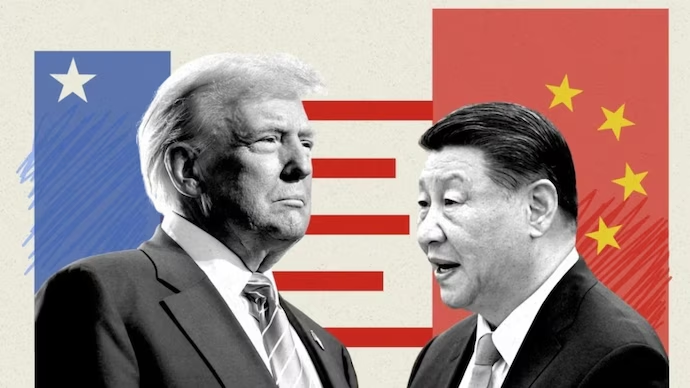
On Wednesday, US President Donald Trump suggested a potential change in the country’s trade policy towards China, indicating that the high tariffs on Chinese goods could be reduced significantly.
Speaking during a White House press briefing, he stated, “145% is very high and it won’t be that high. It’ll come down substantially, but it won’t be zero.” His comments signaled a softer approach compared to his earlier tough stance in the long-running trade dispute between the US and China.
This apparent shift in tone followed remarks made earlier in the day by Treasury Secretary Scott Bessent, who described the current tariff structure as unsustainable. Bessent hinted at a possible “de-escalation” in the trade tensions during a closed-door meeting at an investment conference organized by JP Morgan Chase, according to people familiar with the session.
Financial markets reacted positively to these developments. Wall Street saw a strong rally, with the S&P 500 jumping 2.5 percent. Asian markets mirrored the optimism—Hong Kong’s Hang Seng Index rose 2.5 percent, Japan’s Nikkei 225 gained 2 percent, and South Korea’s Kospi climbed 1.5 percent.
Investors were encouraged by the prospect of a thaw in US-China trade relations, which have caused disruptions in global supply chains and heightened fears of an economic downturn.
The trade conflict began in 2018 when both countries started imposing high tariffs on each other’s goods. President Trump’s administration set tariffs as high as 145 percent on Chinese imports, prompting China to retaliate with up to 125 percent duties on American products.
In addition to tariffs, Beijing has taken steps such as adding US companies to an “unreliable entities list” and restricting exports of key minerals used in high-tech and defense industries.
China has so far maintained a firm position, insisting that any negotiations must be based on equality and mutual respect. Sources familiar with China’s view expressed concerns about inconsistent messages from the US side, even as they remained open to dialogue.
Despite the tension, President Trump emphasized that his relationship with Chinese President Xi Jinping remains strong. He expressed optimism about future cooperation, saying, “We’re going to be very nice. They’re going to be very nice, and we’ll see what happens.” He dismissed suggestions that other sensitive topics like the Covid-19 pandemic would be brought into trade talks, stressing instead the importance of working together.
Trump’s remarks quickly gained attention in China, trending on the social media platform Weibo. Some users interpreted them as a sign that the US might be retreating from its tough trade stance. Meanwhile, the state-run China Daily described the US policy as destabilizing and driven by populist protectionism.
The US administration continues to insist that it is not seeking to sever ties with China, but rather to rebalance the trade relationship. Secretary Bessent reportedly told investors that the goal is fairer trade terms, not complete decoupling. “Neither side thinks the status quo is sustainable,” he said.
While showing flexibility on China tariffs, Trump has not indicated any change to the broader 10 percent tariffs affecting other trading partners, including Japan, India, South Korea, Canada, and the European Union. Negotiations with these countries are still underway.
At the same time, Beijing has been increasing pressure on other nations. Reports from The Korea Economic Daily suggest that some South Korean companies have received warnings from Chinese officials not to sell products containing Chinese rare earth elements to American defense contractors.
Even with the ongoing uncertainties, the White House claims to have received 18 proposals for new trade agreements. Press Secretary Karoline Leavitt noted that all parties involved are eager for a resolution.
Amid these developments, President Trump also touched on the Federal Reserve, a frequent target of his criticism. Though he previously hinted at firing Fed Chair Jerome Powell, Trump now seems to have softened his tone. He stated that while he wants Powell to act promptly, he has no intention of removing him from his position.
