

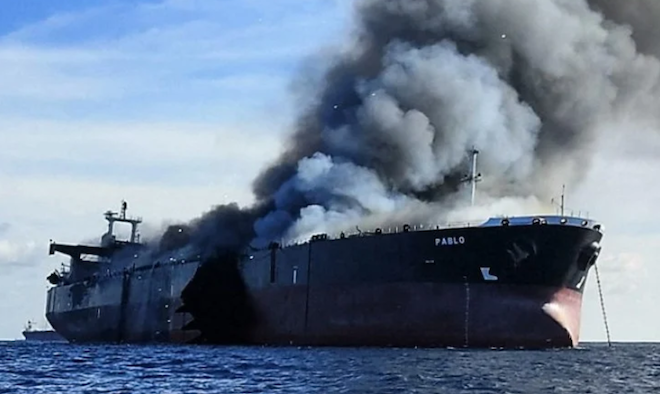

Two large oil tankers caught fire on Friday after a collision in waters near Singapore, the world’s largest refueling port. The incident, which occurred about 55 kilometers (34 miles) northeast of the Singaporean island of Pedra Branca on the eastern approach to the Singapore Straits, resulted in two crew members being airlifted to hospital and others being rescued from life rafts, according to the Maritime and Port Authority of Singapore (MPA).
The Singapore-flagged tanker Hafnia Nile and the Sao Tome and Principe-flagged tanker Ceres I were involved in the collision. The MPA reported that all 22 crew members of the Hafnia Nile and 40 crew members of the Ceres I were accounted for. The fire was reported to the MPA at 6:15 a.m. (2215 GMT).
Photographs released by the Singapore Navy showed thick black smoke billowing from one of the tankers, with crew members being rescued from life rafts and flown to hospitals.
The Hafnia Nile, a Panamax tanker with a capacity of 74,000 deadweight tons (IMO 9766217), was carrying about 300,000 barrels of naphtha, according to ship-tracking data from Kpler and LSEG. The fuel carried by the Ceres I (IMO 9229439), a very-large-crude-carrier (VLCC) with a capacity of 300,000 deadweight tons, was not immediately clear. However, ship-tracking data indicated it had been carrying Iranian crude between March and April.
The environmental authorities in neighboring Malaysia have been alerted to prepare for potential oil spills. The Ceres I had been at the same location since July 11, according to LSEG shipping data. Michelle Wiese Bockmann, principal analyst at Lloyd’s List Intelligence, noted that the area is known for being used by so-called dark fleet ships for the transfer of Iranian oil in violation of U.S. sanctions. She added that the Ceres I has been repeatedly involved in transferring or shipping Iranian oil in breach of these sanctions and has also transported Venezuelan oil to China in recent years.
The China-based owner of the Ceres I could not be immediately reached for comment. China has consistently stated its opposition to unilateral sanctions.
Singapore, Asia’s largest oil trading hub and the world’s largest bunkering port, is situated in waters that are vital trade routes between Asia, Europe, and the Middle East.
