

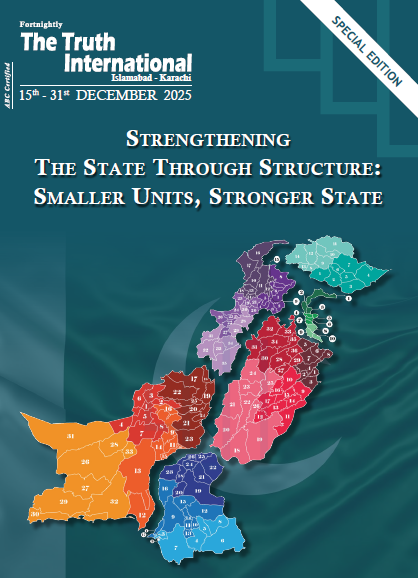

STRENGTHENING THE STATE THROUGH STRUCTURE: SMALLER UNITS, STRONGER STATE
1. Why Reconsider Provincial Boundaries in Pakistan?
Few federations exhibit the degree of spatial and administrative mismatch found in Pakistan. With only four provinces governing a population exceeding 241 million and a territory containing immense ecological, economic, and cultural diversity, Pakistan’s subnational landscape is unusually broad and uneven. Punjab alone administers a population larger than many European states, while Balochistan spans nearly 44% of Pakistan’s landmass but contains only about 6% of its population. This mismatch between territorial scale and administrative capacity has created chronic challenges in governance, service delivery, political representation, and disaster management.
Decades of political economy research suggest that oversized subnational units tend to experience weaker administrative penetration, lower bureaucratic responsiveness, inefficient public goods distribution, and entrenched dominance by centralized elite groups particularly in contexts marked by internal disparities. In Pakistan, demands for new provinces such as South Punjab, Bahawalpur, Hazara, South Balochistan, and an urban Sindh province reflect accumulated grievances arising from political marginalization, developmental neglect, and inequitable resource allocation. Human development indicators consistently reveal stark disparities across regions, with sectors such as healthcare, education, infrastructure, and disaster management performing unevenly within existing provincial boundaries.
