


Exclusive News Analysis
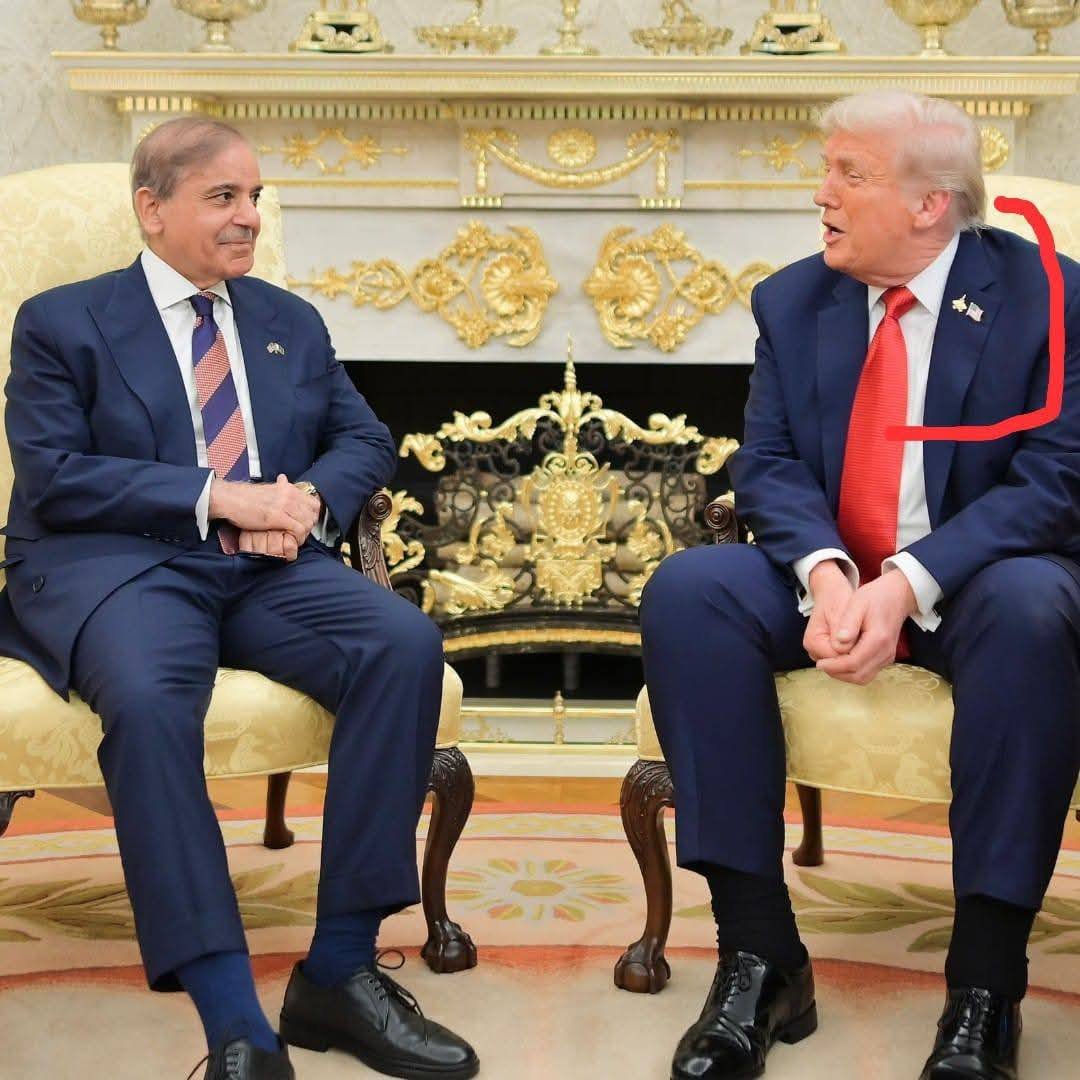
US President Donald Trump is famous for doing stunning things, odd for some circles and amazing for others. On Thursday, Trump pinned the Rafale badge on his left side, and he did this during a meeting with Pakistani Prime Minister Shehbaz Sharif and Field Marshal Syed Asim Munir.
This gesture by Trump has sparked a debate globally. Was it a branding of Rafale or trolling (Bistee/a Punjabi word for insult) of Indian Prime Minister Modi? Most analysts believe that Trump did it deliberately to “welcome” Pakistani leaders during a meeting on Thursday. Prime Minister of Pakistan Shehbaz Sharif is seen on the right side of Donald Trump, while a golden Rafale badge is pinned on the left shoulder of the US President.
Why did the US President do this? There is a strong reason. The Modi-led Indian government has deceived the United States for years. Despite repeated warnings by Trump, Modi’s government kept on buying oil from Russia. Another annoying thing for Trump was Modi’s tilt towards his arch-rival, China, soon after the US administration imposed 50 percent tariffs on imports from India.
Analysts in the United States also opined that India had been taking advantage of the US soft policies and, in return, gave nothing to America. This is the reason Donald Trump pulled up the Indian regime and imposed 50 percent tariffs that shocked Indians. Trump’s fury against India did not end here, and he also ordered the deportation of thousands of Indian migrants and made a massive hike in the fee for the H-1B visa to $100,000. It was another unexpected shock for Indians, who were the key beneficiaries of the H-1B visa policy.
Coming back to the Rafale badge debate, the US analysts think that the United States administration should strengthen ties with Pakistan instead of India, which would be in the US national interest. And this sudden change in the US policy appears to be an outcome of the recent defeat of India in the war with Pakistan in May this year. From May 7-10, India initiated war with Pakistan, but when Pakistan retaliated with full vigor, the Indian government was left with no other choice but to seek Trump’s help for an immediate ceasefire.
In this short war, Pakistan emerged as a stronger military power than India, and this development led to a global diplomatic shift in favor of Pakistan.
Saudi Arabia-Pakistan Defence Pact: Thank You, Modi
Pakistanis must be grateful to Indian Prime Minister Narendra Modi, whose misadventure of war with Pakistan in May this year turned out to be a blessing in disguise for Pakistan. In May this year, the Modi-led extremist Indian government ordered an attack on Pakistan on May 7, using the lame excuse of the Pahalgam false flag operation. First, India sent dozens of Israeli drones towards Pakistan, which were downed or fell in different parts of the country. Some drones also reached Rawalpindi, the city that hosts GHQ (General Headquarters of the Pakistan Army). On the following day, India targeted Noor Khan and some other airbases in Pakistan.
For two days, Pakistan kept on warning Modi and his government of tough retaliation, asking them to refrain from attacking Pakistan. However, the inflexible, extremist, and duffer Indian Prime Minister continued to attack Pakistan. Interestingly, the Indian media also started humiliating Pakistan as the Pakistani Army did not retaliate for the first two days of the Indian-imposed war.
Finally, the decisive moment came, and Pakistan Army retaliated in a manner that stunned the whole world, and Pakistanis felt proud of their army for teaching a bitter lesson to arch-enemy, India.
How did Pakistan ruin the military might of India in less than two days? It is a very interesting scenario. First of all, Pakistan also attacked India with drones that reached everywhere, even in the capital city of India.
Nonetheless, the decisive retaliation was noted on the morning of May 9, when Pakistani armed forces jammed the air defence system of India, destroyed the Russian S-400 defence system, and blew up a weapons depot carrying the latest Indian missiles. Pakistan also jammed power grid stations, causing a blackout in most parts of India. The Pakistani army also attacked Indian military bases with ballistic missiles.
World’s longest Dogfight of fighter jets
The most interesting part of this four-day war was the dogfight between Pakistani and Indian fighter jets. In this aerial war, the fighter jets of both countries remained within their boundaries and did not cross into the rival country’s territory. How did this war turn Pakistan into a strong and undefeatable military power? This is also a very interesting development. Pakistan used the most modern J-10C fighter jets made with Chinese technology. Pakistani armed forces also used long-range Chinese PL-15/E missiles, which destroyed five/six Indian fighter jets, including the most modern and expensive Rafael jet(s). The PL-15/E missile has the capacity to hit the target up to a 400-km distance. When Pakistan targeted Indian fighter jets, they were flying 200 km away from the Pakistani territory while Pakistani jets were also 200-km away from their territory. Hence, PL-15/E was the only missile to hit Indian jets. Also, PL-15/E missile cannot be detected by the radars or any other defence system.
Hence, targeting the Indian jets with PL-15/E missiles was an easy task. Pakistani Foreign Minister Ishaq Dar also pointed out after the war that the Pakistan Army targeted only those Indian fighters jets that attacked Pakistan and spared other fighter planes of the arch-rival. He said that the Pakistan army could have destroyed dozens of Indian fighter jets at that time.
The way the Pakistan army bashed India in this brief war, the Indian government left with no other option but to seek Trump’s help for an immediate ceasefire. The recent statement of Indian Foreign Minister Jaishankar also admitted that “We were told by Americans that Pakistan will retaliate with more vigor and cause massive damage to India.”
To sum up, Pakistan has proved its military might in the recent brief war with India.
In this war, the Pakistan army destroyed French, Russian, Israeli, and Indian war technologies. Pakistan also demonstrated that Chinese war technology is the best in the war. The fighter jets J-10/C and JF-17 Thunder, PL-15/E missiles, etc., proved to be the best war weapons against the arch-enemy of Pakistan. This is the reason that global powers now consider Pakistan a powerful military in comparison with India, and Chinese war technology has emerged as a combat-tested, successful technology. Since the Pak-India war in May 2025, dozens of army chiefs and defence ministers of different countries have visited Pakistan and met the army chief and other military leaders to discuss the victory of Pakistan, the technology Pakistan used in the war and the unimaginable bravery of Pakistani armed forces in this short war.
Pakistan and Saudi Arabia sign a Defence Agreement
On Thursday (Sept 17), Pakistani nation felt more proud of their armed forces when Saudi Arabia and Pakistan issued a joint statement in Riyadh about Pakistan-Saudi Arabia’s Defence Agreement. The agreement pledges that any attack on one country will be considered an attack on both. This new chapter strengthens nearly eight decades of defence, economic, and cultural ties between the two nations. This milestone is an outcome of Pakistan’s hilarious victory in the war against India. Pakistan is a nuclear power, and its armed forces are capable of defeating India and Israel. The recent Israeli attack on Doha, Qatar, may have influenced Saudi Arabia to sign a bilateral defence pact with Pakistan, because Pakistan is the only Muslim country that is capable of teaching a lesson to Israel, India, or any other enemy country.
Saudi-Pak Defence Pact: A Commitment to Joint Security
The pact emphasizes the shared determination of both countries to enhance defence cooperation and maintain peace across the region. According to the agreement, any form of aggression against one nation will trigger a united response. Officials highlighted that this deal is rooted in historic brotherhood, Islamic solidarity, and long-standing strategic interests.
Strengthening Defence Collaboration
Pakistan and Saudi Arabia already share deep defence cooperation. With this agreement, military collaboration will expand further to include modern deterrence strategies. Both governments expressed confidence that the pact will help deter threats, while ensuring the protection of regional and global stability.
The document also reaffirmed the importance of closer military ties. Leaders from both sides stressed that the agreement will serve as a framework for stronger coordination between their armed forces.
Diplomatic Engagements and Leadership Commitments
Prime Minister Shehbaz Sharif, Saudi Crown Prince Mohammed bin Salman, and senior officials attended the signing ceremony at Yamama Palace. Pakistan’s Chief of Army Staff, Defence Minister, and key cabinet members were also part of the delegation.
During the meeting, the leaders reviewed their historic ties and discussed pressing regional and international issues. Prime Minister Shehbaz expressed gratitude for the warm reception and extended best wishes to King Salman and the Saudi people. In return, the crown prince wished prosperity for Pakistan and reaffirmed Saudi Arabia’s commitment to further strengthening bilateral relations.
Symbolic Gestures of Friendship
Upon entering Saudi airspace, the prime minister’s plane was escorted by Saudi Air Force jets. This gesture of solidarity underscored the depth of the brotherly relationship. Additionally, the prime minister was welcomed with a guard of honour on his arrival in Riyadh.
Such symbolic acts reinforced the special partnership that both nations describe as unique within the Muslim world. Officials emphasized that the gestures were not only ceremonial but also a recognition of Pakistan’s importance in regional security.
Expanding Bilateral Cooperation
Beyond defence, Pakistan and Saudi Arabia are working to expand cooperation in trade, economy, culture, and environmental initiatives. Recent meetings between Pakistani and Saudi officials have highlighted investment opportunities and collaboration in renewable energy, infrastructure, and industry.
About The Truth International
The Truth International (TTI), based in Islamabad, is a private organization, doing research work/projects and running its print and digital media wing _ a website, a fortnightly magazine, a YouTube Channel, and social media pages on all platforms. Stay up to date by staying connected to The Truth International.
