


Nationwide Protests
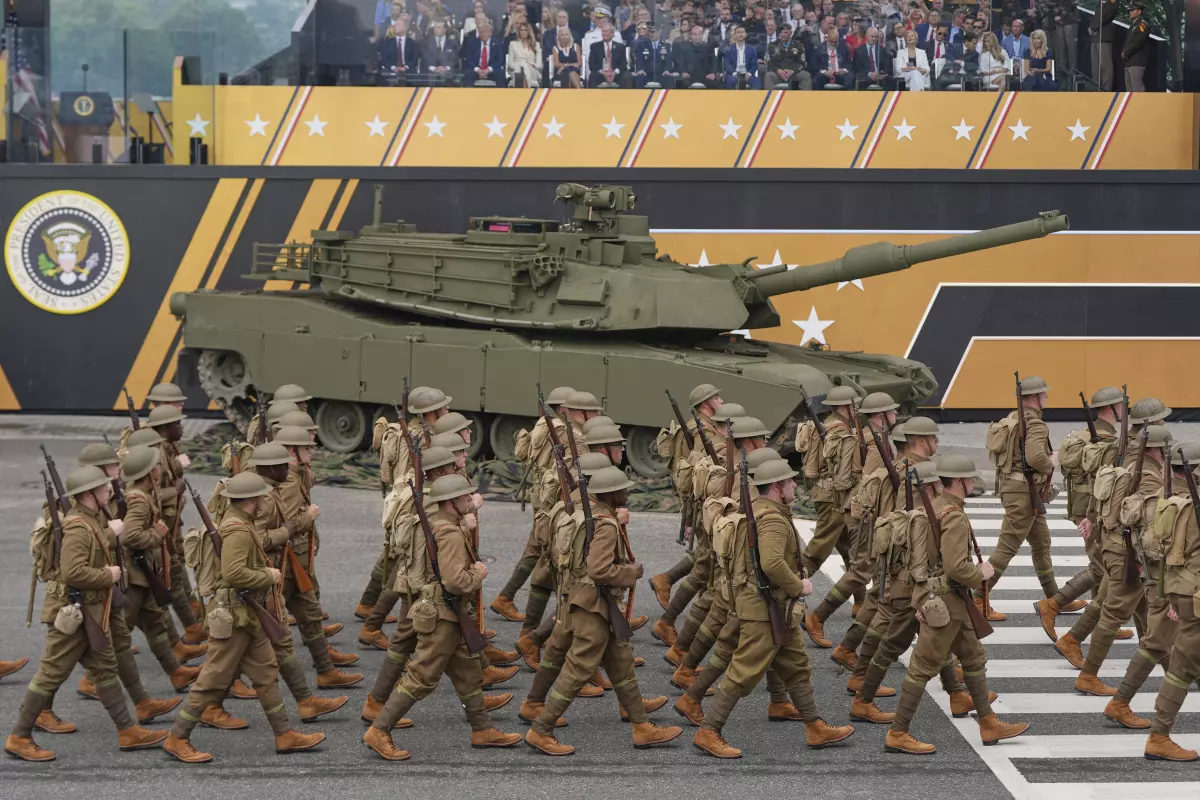
On Saturday, President Donald Trump’s long-awaited military parade rolled through downtown Washington, D.C., showcasing tanks, artillery, and thousands of troops in celebration of the U.S. Army’s 250th anniversary.
While the display of military power was meant to project strength and national pride, the spectacle was overshadowed by a day of widespread protests, political unrest, and violence across the country.
The parade coincided with Trump’s 79th birthday and included a massive deployment of military hardware along Constitution Avenue, a rare sight in the United States. More than 7,000 soldiers and 150 military vehicles — including M1 Abrams tanks, Stryker armored personnel carriers, and Paladin artillery units — participated in the event.
Trump, flanked by members of his cabinet including Secretary of State Marco Rubio and Defense Secretary Pete Hegseth, observed the parade from behind bulletproof glass. The celebration traced the Army’s history from the Revolutionary War to modern-day conflicts, with Trump standing and saluting troops as they passed.
Despite the grand display, tensions were high across the nation. In the hours before the parade, hundreds of thousands of protesters gathered in cities including New York, Chicago, Los Angeles, and Washington, condemning Trump’s policies and actions since returning to power in January.
Protesters marched under the theme “No Kings,” with slogans like “No crown for a clown” and “Marines, get out of LA!” echoing through the streets. Actor Mark Ruffalo joined demonstrators in Manhattan, and protests were held in nearly 2,000 locations nationwide.
Tragically, the day was marked by a deadly shooting in Minnesota, where a Democratic lawmaker was assassinated and another injured by a gunman who remains at large. The violence only intensified fears that the nation is slipping further into unrest.
In Los Angeles, where recent federal immigration raids sparked major protests, tensions boiled over. Federal forces, including National Guard troops and U.S. Marines, were deployed on Trump’s orders—despite opposition from California Governor Gavin Newsom.
Demonstrators clashed with police, who responded with gas, flash bangs, and mounted officers. Protesters retaliated with commercial-grade fireworks, rocks, and bottles, vowing to continue resisting what they called authoritarian tactics.
Meanwhile, international tensions added another layer to the day’s turmoil. Israel and Iran exchanged further missile and drone attacks, fueling fears of a wider Middle East conflict. The Israeli strike on Iran’s South Pars gas field — the largest in the world — caused a major fire and partial suspension of gas production.
Tehran has threatened to close the Strait of Hormuz, a vital chokepoint for global oil supplies, as the confrontation escalates.
Back in Washington, Trump’s parade proceeded under tight security. While thousands of his supporters cheered the military display, anti-Trump protesters also lined parts of the route.
Some were separated by barriers and police, while others held signs denouncing the event as wasteful and symbolic of authoritarianism. Critics highlighted the parade’s massive cost — estimated between $25 million and $45 million — as excessive amid Trump’s own pledges to cut government spending.
Bryan Henrie, a Trump supporter from Texas, defended the display. “I don’t see a controversy,” he said. “I will celebrate safety and stability any day over anarchy.”
But many Americans felt differently. Cooper Smith, a 20-year-old protester from upstate New York, voiced concerns about the administration’s rhetoric and policies. “We’re seeing dehumanizing language towards LGBT people, towards people with autism, towards racial minorities, undocumented people,” he said. “Somebody’s got to show that most Americans are against this.”
As night fell, the parade ended, but the national unrest it coincided with showed no signs of easing. Protesters promised to continue their demonstrations, and Trump’s warning that demonstrators would face “very big force” only raised alarms further.
Sunsara Taylor, a founder of RefuseFascism.org, summed up the sentiment of many gathered in Washington: “Today we refuse to accept Donald Trump unleashing the military against the people of this country. We say, ‘Hell no.’”
