


Trump
U.S. President Donald Trump announced a significant escalation in his trade policy by declaring that steel and aluminum import tariffs will be doubled to 50 percent, effective Wednesday, June 4. The move marks another bold step in his continued effort to protect American industries from foreign competition, a hallmark of his economic agenda.
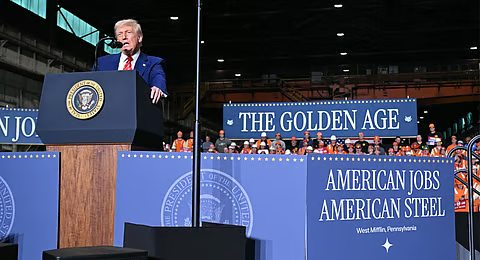
Speaking at a U.S. Steel plant in Pennsylvania — a crucial swing state that played a pivotal role in his electoral victory — Trump emphasized the need to fortify domestic production. “We’re going to bring it from 25 percent to 50 percent, the tariffs on steel into the United States of America,” he told an audience of industrial workers, adding, “Nobody’s going to get around that.”
Trump later confirmed on Truth Social that the new tariff rate would apply not only to steel but also to aluminum imports. The sharp increase is the latest in a series of trade actions taken since Trump returned to the presidency in January, affecting both adversaries and traditional allies. These measures have disrupted global trade flows and stirred volatility in financial markets.
Earlier this week, a federal court temporarily ruled that Trump may have exceeded his authority with these tariffs. However, an appellate court has since allowed the duties to remain in effect while the legal process continues.
Trump also addressed concerns surrounding the proposed partnership between U.S. Steel and Japan’s Nippon Steel — a deal previously blocked by former President Joe Biden on national security grounds. Trump maintained that “U.S. Steel will continue to be controlled by the USA,” attempting to ease concerns about foreign control and potential job losses.
He said the agreement would result in no layoffs or outsourcing, and promised substantial investment, including a $2.2 billion expansion at the Mon Valley Works-Irvin plant and an additional $7 billion for modernization and mining efforts across the U.S.
Despite Trump’s reassurances, skepticism remains. The United Steelworkers union (USW), which represents many of U.S. Steel’s employees, criticized the lack of consultation and transparency. USW President David McCall stated, “We cannot speculate about the meaning of the ‘planned partnership.’ Our primary concern remains with the impact this merger will have on national security, our members, and our communities.”
While Trump had opposed the U.S. Steel-Nippon deal during his campaign, his recent statements indicate a potential softening of that stance — so long as American control and jobs are preserved. However, many remain cautious, warning that “the devil is always in the details.”
