

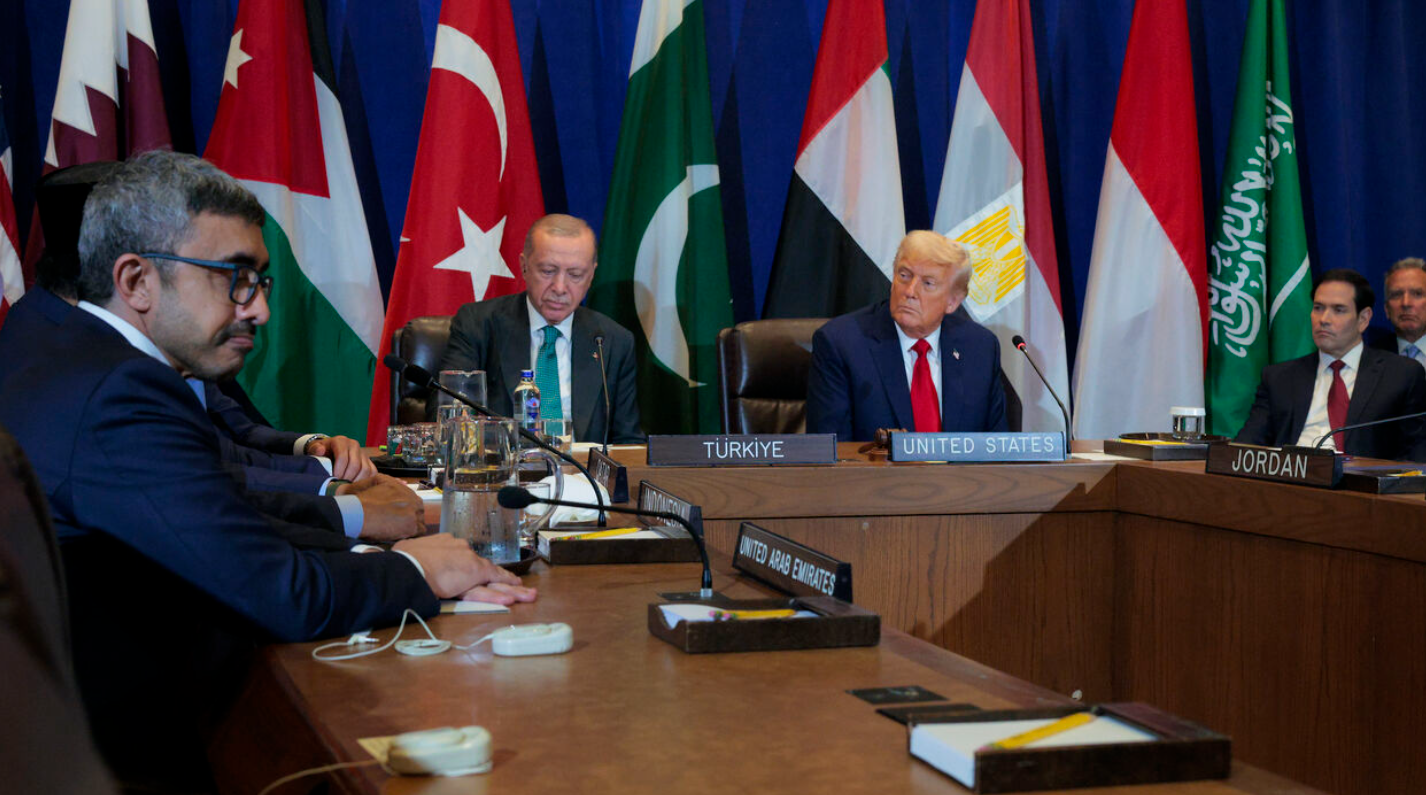

Former US President Donald Trump has presented a new plan for ending the war in Gaza, seeking direct support from Muslim leaders during the 80th United Nations General Assembly in New York. His proposal emphasizes a ceasefire-for-prisoners deal, phased Israeli withdrawal, and reconstruction efforts led by regional and international partners.
A High-Level Multilateral Meeting
The meeting, held on the sidelines of the UNGA, brought together leaders from Pakistan, Saudi Arabia, Qatar, the United Arab Emirates, Egypt, Jordan, Turkiye, and Indonesia. Prime Minister Shehbaz Sharif attended the gathering alongside Foreign Minister Ishaq Dar, signaling Pakistan’s readiness to engage in regional peace efforts.
Addressing the Muslim leaders before formal consultations, Trump declared: “We have to get the hostages back. This group can do it better than anyone else in the world.” He emphasized that the war in Gaza must end immediately and expressed confidence that Muslim countries could play a decisive role in shaping a settlement.
Qatari Emir Sheikh Tamim bin Hamad Al Thani praised the timing of the initiative, stressing that the focus should remain on halting the war and ensuring the release of prisoners.
UNGA Speech and Strong Positions
Earlier, Trump used his speech at the UNGA to oppose growing calls for Palestinian statehood recognition, arguing that it would reward violent acts carried out by Hamas. Instead, he urged world powers to work toward a ceasefire agreement that prioritizes the safe return of all hostages, whether alive or deceased.
He reiterated the need for “immediate negotiations” to secure peace in the region, framing his plan as a practical alternative to unilateral recognition of Palestine.
Prime Minister Shehbaz Sharif welcomed Trump’s stated commitment to peace, recalling how the former US president had previously played a role in reducing tensions between India and Pakistan. However, Shehbaz chose not to comment further on the Gaza-specific meeting until after its conclusion.
Outlines of the Peace Plan
According to diplomatic sources, Trump’s plan outlines a phased Israeli withdrawal from Gaza, followed by the deployment of regional peacekeeping troops. These forces would maintain order while an internationally backed transition and reconstruction program rebuilds the enclave.
The framework includes a role for the Palestinian Authority but excludes Hamas, which Washington and Tel Aviv insist must be dismantled before any settlement. Arab and Muslim countries are expected to contribute troops and financial aid to stabilize Gaza during the transition.
Although Israel has not authored the plan, its leadership has reportedly been briefed on its broad outlines. Prime Minister Benjamin Netanyahu is said to have been informed, though no official Israeli endorsement has been made public.
Reactions from Washington
US Secretary of State Marco Rubio described the initiative as “one last shot” to end the conflict. Speaking to American media, he stressed that only a negotiated settlement could ensure a permanent solution.
Rubio added that Palestinians would ultimately have their own governing territory, but such a state must not become a launchpad for attacks on Israel. He highlighted the dual objectives of freeing prisoners and ensuring long-term security guarantees for Israel alongside humanitarian relief for Gaza.
What Comes Next?
While official statements following the meeting were pending, the gathering underscored a growing recognition that Muslim-majority nations hold significant influence in shaping Gaza’s future. Trump’s effort to align with them suggests a strategy that relies on regional cooperation rather than unilateral US-led diplomacy.
If implemented, the plan could mark a turning point in the Gaza crisis by linking ceasefire, prisoner release, and reconstruction into a single framework. However, challenges remain, particularly over Hamas’s exclusion and questions of Palestinian self-determination.
For now, Trump has placed responsibility squarely on Muslim leaders, declaring that their collective action could determine whether Gaza finally moves toward peace or remains trapped in conflict.
