

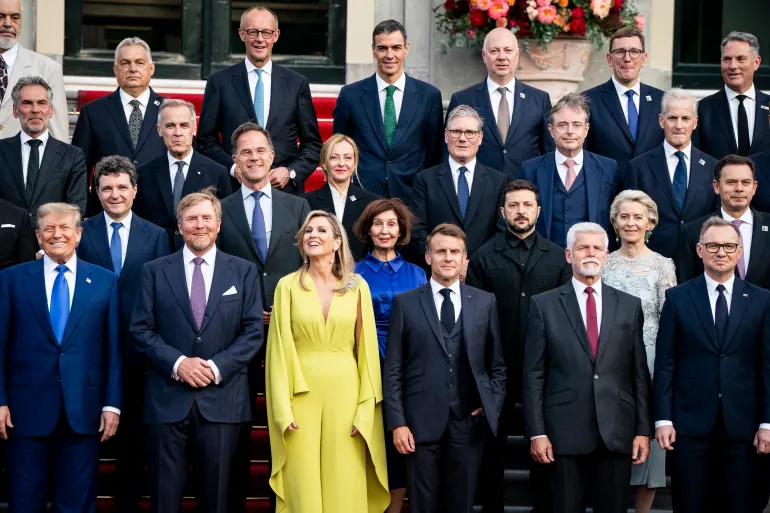

U.S. President Donald Trump has cast doubt on whether Washington would fully uphold the mutual defense commitments outlined in the North Atlantic Treaty Organization (NATO) charter, signaling a more conditional stance on the alliance’s cornerstone principle.
Speaking to reporters aboard Air Force One en route to The Hague for the annual NATO summit, Trump said U.S. obligations under Article 5—the clause stipulating that an attack on one member is considered an attack on all—would depend on interpretation.
“It depends on your definition,” Trump said on Tuesday. “There are numerous definitions of Article 5. You know that, right? But I’m committed to being their friends.”
While emphasizing he is “committed to saving lives” and “committed to life and safety,” Trump declined to elaborate further, citing his preference not to “talk in detail while flying on a plane.”
Article 5 has long been viewed as the bedrock of NATO’s collective security, originally designed to counter Soviet threats during the Cold War. Trump’s ambiguity has raised concerns among some allies, particularly amid ongoing conflicts in Ukraine, Gaza, and the broader Middle East.
NATO Secretary-General Mark Rutte attempted to reassure reporters later in the day, stating he had “no doubt” about continued U.S. support for NATO and its foundational defense commitments.
Pressure to Spend More
The summit’s main focus is a proposed increase in defense spending across NATO’s 32 member states. The Trump administration has repeatedly criticized alliance members for failing to meet current targets and is now demanding an even steeper increase.
Trump has called for all members to raise their defense spending to 5% of GDP, more than double the current 2% benchmark. He has questioned the alliance’s willingness to defend countries that don’t meet this threshold and has again floated the possibility of the U.S. withdrawing from NATO if its demands go unmet.
European Commission President Ursula von der Leyen, speaking ahead of the summit in The Hague, said member states are poised to adopt “historic new spending targets,” calling it a response to changing global threats.
“The security architecture we relied on for decades can no longer be taken for granted,” she said. “This is a once-in-a-generation tectonic shift.”
