


U.S.-China Trade War Reignites with Heavy Tariffs
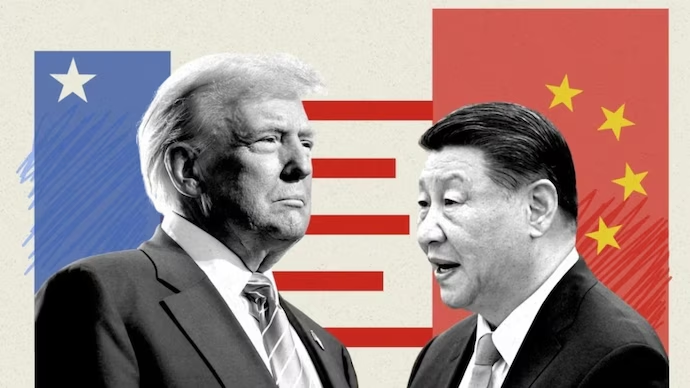
The trade conflict between the United States and China has flared up again after President Donald Trump announced a sweeping 100% tariff on Chinese imports. Alongside this, Washington is introducing new export restrictions on sensitive U.S. technologies. Trump said these moves, which take effect next month, are meant to protect American economic and national security interests.
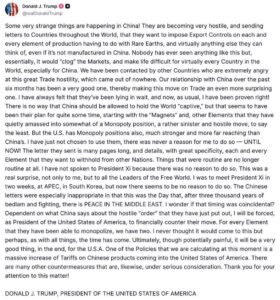
On social media, Trump claimed, “Some very strange things are happening in China! They are becoming very hostile.” He also accused Beijing of trying to “hold the world captive” through its control of critical materials.
The announcement triggered sharp market reactions. The S&P 500 fell 2.7%, marking its worst drop since April. Trump also hinted at cancelling a planned meeting with Chinese President Xi Jinping, though he later confirmed he would still attend.
The tariffs come just months after a brief period of trade calm in May, when both nations had agreed to lift prior sanctions and restart negotiations.
Beijing Responds with New Rare Earth Export Controls
In a swift counter, China’s Ministry of Commerce released “announcement number 61 of 2025,” expanding its rare-earth export controls. The directive adds five more critical elements—holmium, erbium, thulium, europium, and ytterbium—to its restricted list. This brings the total number of restricted rare-earth elements to 12 out of 17.
Beijing also introduced export limits on specialized refining equipment, which are essential for rare-earth processing. These new rules take effect December 1 and require foreign companies to apply for Chinese government approval before exporting even trace amounts (as low as 0.1%) of rare-earth materials.
China defended the restrictions on national security grounds, saying these materials have dual-use potential in civilian and military sectors.
Global Industry Faces Disruption as Strategic Showdown Escalates
Rare-earth metals are vital to the production of smartphones, electric vehicles, semiconductors, and advanced weaponry, including U.S. military systems like F-35 jets and Tomahawk missiles. China dominates this space—mining 60% and refining 90% of the global supply.
Analysts warn that tighter Chinese controls may spark fresh disruptions across global supply chains and intensify the geopolitical power struggle. The move also increases China’s leverage as both nations gear up for a high-stakes summit in South Korea later this month, where trade and technology issues are expected to take center stage.
As tensions mount, a new chapter in the U.S.-China trade war appears to be unfolding, with global markets and industries caught in the crossfire.
