

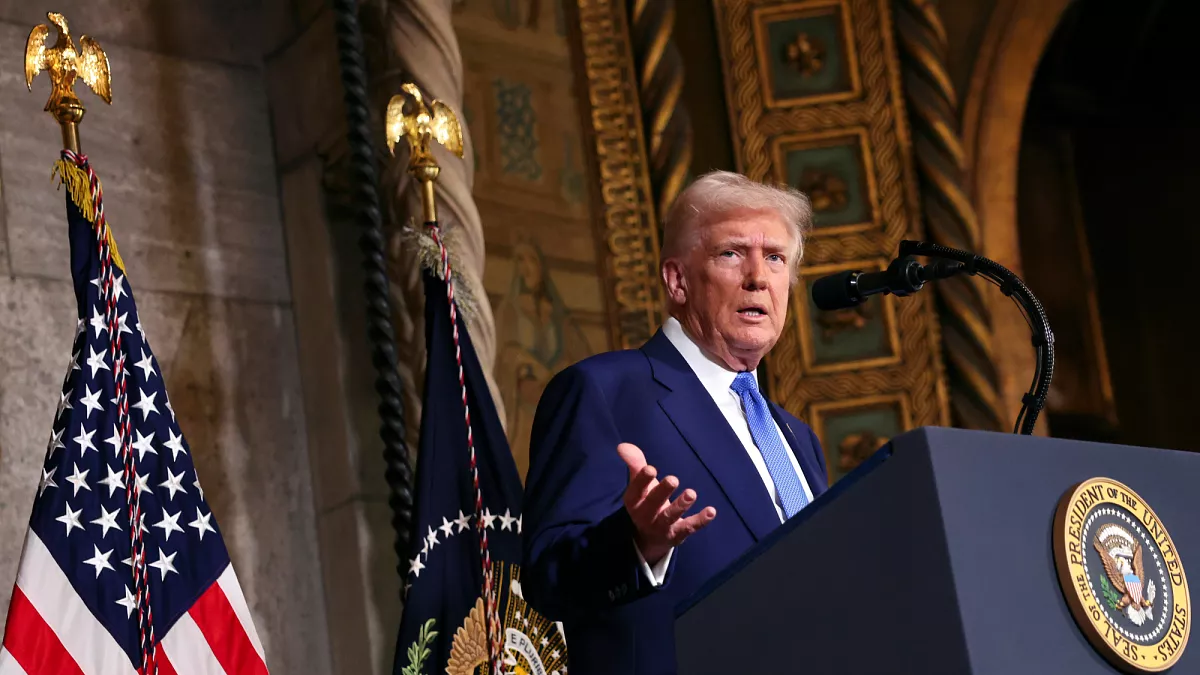

President Donald Trump announced on Tuesday that the United States will impose a 50% tariff on all steel and aluminum imports from Canada, doubling the previously planned rate. The move comes in response to Ontario’s decision to impose a 25% tariff on electricity exports to the U.S.
In a statement on his Truth Social platform, Trump directed the Commerce Department to implement the increased tariffs starting Wednesday morning. He also demanded that Canada immediately eliminate what he called an “Anti-American Farmer Tariff,” which ranges from 250% to 390% on various U.S. dairy products. Trump further warned that he would soon declare a national emergency concerning electricity in the affected areas.
The president also threatened to significantly raise tariffs on Canadian automobiles beginning April 2 if what he described as “longstanding unfair tariffs” were not removed.
Ontario Premier Doug Ford responded to Trump’s announcement on X, stating that he would not back down until all U.S. tariffs on Canadian imports were permanently lifted. Ford’s government recently increased electricity prices for parts of New York, Michigan, and Minnesota, triggering the trade dispute.
The escalation in tariffs sent shockwaves through financial markets. The S&P 500 index fell nearly 1%, reflecting investor concerns that the new tariffs could hinder U.S. economic growth and drive inflation higher. The Toronto Stock Exchange’s S&P/TSX Composite Index also declined by 0.5%, while the Canadian dollar weakened against the U.S. dollar.
Starting Wednesday, a broader 25% tariff will apply to all steel and aluminum imports into the U.S., affecting shipments from Canada, Brazil, Mexico, South Korea, and other countries that previously benefited from exemptions. Trump emphasized that these tariffs would be enforced uniformly, without exceptions, as part of his effort to bolster domestic industries.
Since taking office in January, Trump’s aggressive tariff policies have unsettled investors, businesses, and consumers. Analysts warn that the economic uncertainty created by these measures could increase the likelihood of a recession. A recent survey of small businesses indicated declining confidence for the third consecutive month, erasing the optimism that followed Trump’s re-election in November.
Economists in the U.S., Canada, and Mexico are increasingly concerned about the economic impact of these tariffs. A recent poll showed that 70 out of 74 economists believe the risk of a recession has grown, with inflationary pressures in the U.S. becoming a significant concern.
