


Towards New Normal: United States and Israel quietly enforce the “Abraham Accord”
By Naqi Akbar
KARACHI: The least expected thing happened in the week ending September 14, 2025. The IDF jets, with close aerospace cooperation from the Saudi and Hashemite Jordanian kingdoms, struck targets in the Qatari capital Doha urban areas, citing the presence of Hamas leadership. For a few, it might have been the IDF’s ‘legitimate’ right to strike, but for many, it was like the IDF, with the complete connivance of the United States and United Kingdom, crossing all psychological and moral barriers to bomb as and when they required that to be done.
Last year, when such strikes happened in Iran first, when Hania was murdered, and again in Beirut when Nasrullah was targeted, there was a consensus and impression that the IDF treated both Tehran and the Shia enclave in Beirut as enemy areas and thus legitimate targets to bomb. The targeting of the Hamas leaders, who narrowly escaped due to some intelligence tip off from any of the compliant states and the Air Force’s air defence systems in the region, was what can be called the “new normal” in the current geo-political scenario, where for the IDF the whole world canvas is combatant territory.
That new normal has not just been witnessed in the context of the IDF. Indian war gaming in the name of fighting the so-called terror outfits also crossed many barriers this May 2025. There has been a general impression that ‘grounded militants’ of ‘Jihadi outfits’ are generally tracked by the Indian intel sleuths and in the most cases silently gunned down without much fanfare.
The midnight strikes on May 7, 2025 completely changed the rules of the game. Complete seminaries; who might not have much to do with the actual militant structures were targeted by million dollars’ worth jets like Sukhoi or Dassault Rafale, in a way suggesting that Indian military planners threw to the dust more cost-efficient methods of fighting militancy and rather making it a photo op for the international media. Furthermore, the Indians broke many of their own red lines. In the case of Pakistan, the use of air force and army aviation has been in practice since the days of Faqir of Api to Marri tribes in Baluchistan to the scenarios in the war on terror. In the case of Indian separatist movements, Indians have been at least meticulous to stick to intelligence agencies inputs, Central Reserve Police Force (CRPF) within their own territory.
Consequently, the pressure on Pakistan to respond despite initial restraint was obvious in the eyes of the international politics observers. Pakistan predictably avoided collateral damage and went for the hardware; foremost amongst them the S 400 advanced air defence systems. In that context the Pakistani and Iranian methodology was similar; ‘do not take’ the ‘collateral damage’ baggage, instead hit the enemy hardware where it hurts the most. In the case of 4 days India Pakistan conflict or the 12 days Israel Iran war, human lives loss was high in the case of Pakistan and Iranian civil casualties, while both Pakistan and Iran hit specifically at military assets.
Back to the Middle East, there are fears that Israel might shed away the inhibition of so far not striking any target in Turkey. The fears rest in the fact that an economic ally like Qatar from whom Israel gets natural gas for its energy needs has been recklessly attacked. Further over the years there has been a general understanding between the United States, IDF and Qatar that the Hamas will be kept in check; and unlike Iran, where Hamas is more at home for the want of logistics, the Qatari job is to keep tabs without doing much in men and material.
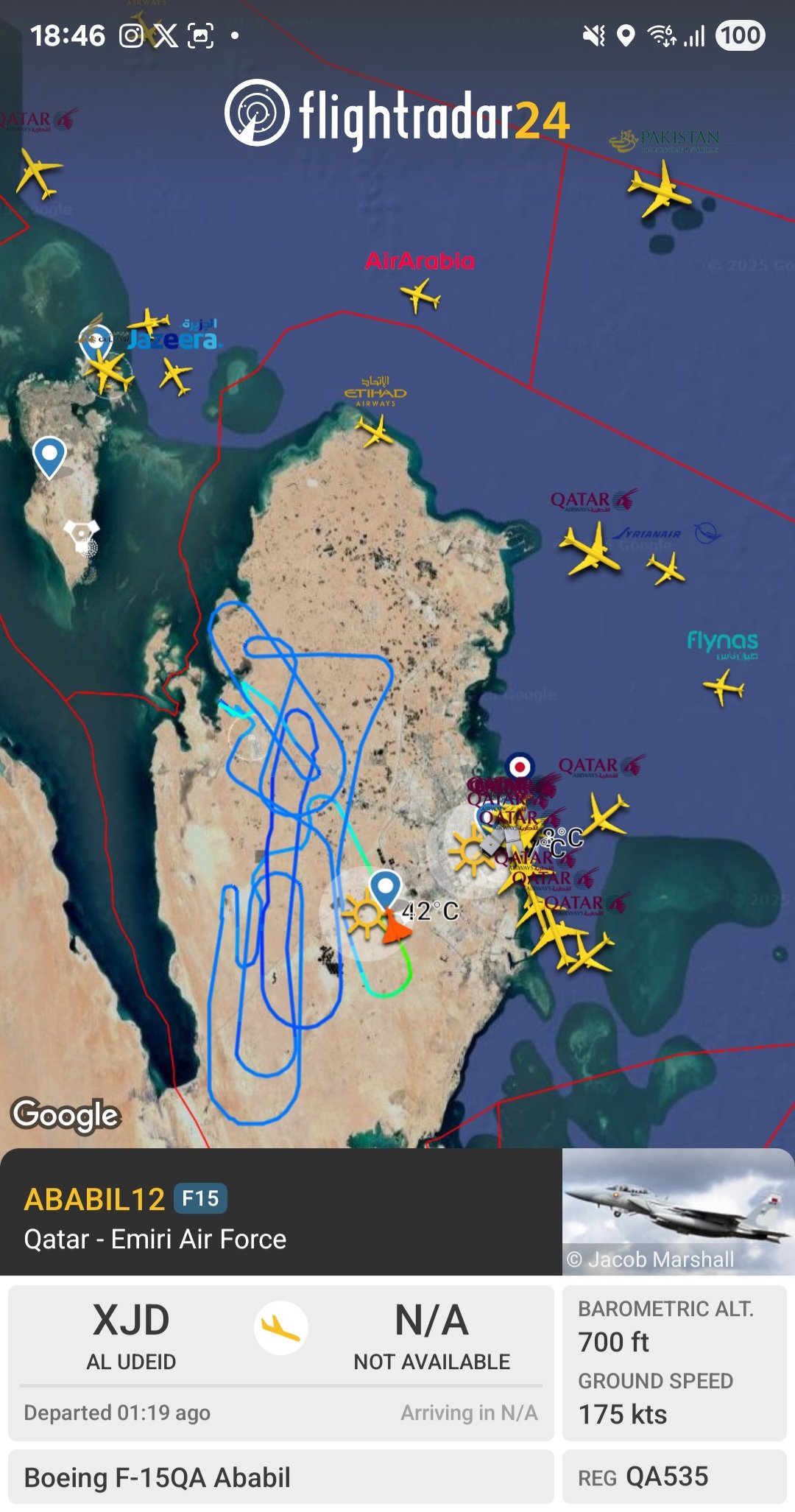
A close forensic analysis of the day and timing of the attack reveal that despite the presence of Udaid AFB in the near proximity with Qatari Air Force F-15 and Rafale jets parked on tarmac, there was no movement from them when the air defence might have noticed the IDF packs crossing over the Saudi air space.
International aviation information services like Flight Radar also point out to the fact that at that time a F 15 jets of Qatari Air Force were apparently shown on the radar, with RAF Boeing jets also nearby for reasons unknown. Despite the Qatari foreign office denials and condemnations, and MBS flash visit to the Qatari capital Doha, things were and are very apparent.
The Kingdoms have now proven in broad day light that they are not even able to save the reputation of their comrades in arms, whether they are the fellow monarchies or are fellow Arab combatants like Hamas. They seem to have quietly accepted that can be called the new air superiority of the IDF, which regretfully stretches as far as the Persian Gulf area, the only area where they get an equal response is Yemen. With Iran politically fragmented, there are lean chances of a swift and prompt response and there is ample chance that due to the motivational disarray, any future IDF strike on Uran can actually cause a regime change or the collapse of the regime as the result of the military rout. The reform group insistence on talking to IAEA, effective cornering of Rahbar and IRGC all point out to the eventual domination of the IDF in the days to come.
With a neutralized Iran, decapitated resistance and lame duck Arab league, there is not much in store for the other Muslim States, spread from South Asia to Far East as regretfully the instrument of surrender has been signed metaphorically by the prime stakeholders.
That surrender in fact heralds the new world order, which came out of the October 7 Hamas incursion of the occupied territory. Despite the wishful thinking that the resistance might have taken on the IDF full blast, the overthinking mode allowed the IDF and its backers enough time to manipulate things as they wanted them to be.
As things stand the situation in Middle East is deeply fragile. Any move towards challenging the IDF can precipitate a war or a response from IDF which can be devastating to say the least. The practical cut off of the resistance from Iran, thanks to the Zarif administration has created a situation where the final change of scene not just in Iran, but in the whole Middle East for the benefit of the success of the Abraham Accords is very much visible.
Conclusively, not much can be expected from the stakeholders ranting of response as their compromised airspace access to the IDF has been the cause of that new military enforcement of the “Abraham Accord”. It only remains to be seen if there are surprises from the rejectionist camp in the form of that phrase that “they are down but not out”.
