

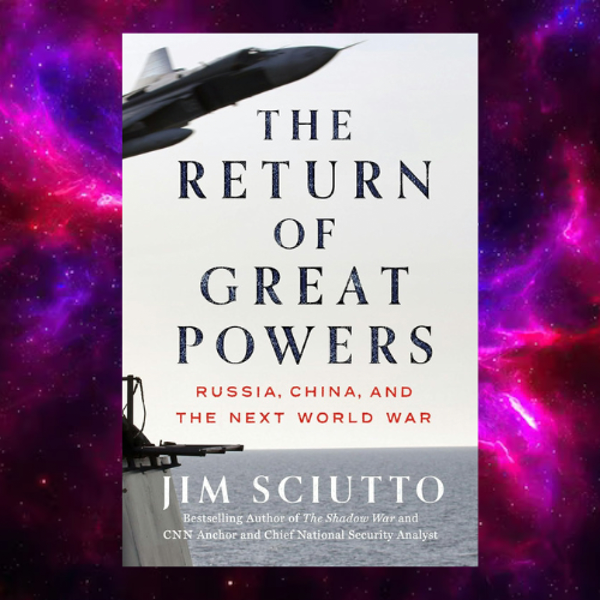

“The Return of Great Powers” by Jim Sciutto, CNN anchor and Chief National Security Analyst, stands out as a meticulously researched and timely exploration of the evolving global geopolitical landscape dominated by the resurgence of traditional great powers. In a world increasingly defined by complex international relations and strategic manoeuvring, Sciutto’s analysis offers profound insights into the dynamics shaping our present and future.
Sciutto opens his book with poignant conversations that set the stage for his exploration. One such dialogue is with CIA Director Bill Burns, who highlights the dual challenge of contemporary great power rivalry: “we are playing without a net.” This underscores the high-stakes nature of modern geopolitical competition. Another significant interview is with Jens Stoltenberg, former NATO Secretary General, reflecting on the optimism of the post-Cold War era and the current challenges to global democracy posed by geopolitical realities.
The author begins by contextualising Finland’s nuanced position in 2021, balancing relations between Western Europe and Russia while remaining outside NATO. President Sauli Niinistö’s cautious engagement with Russia contrasts sharply with Finland’s condemnation of Russia’s actions in Ukraine, highlighting the complexities of Helsinki’s diplomacy.
He further discussed Vladimir Putin’s strategic manoeuvres, including the annexation of Crimea and the invasion of Ukraine, are analysed in depth. Sciutto explores how Putin’s control over historical narratives and institutions has justified these actions, despite widespread international condemnation and anticipation of Russia’s “shock and awe” tactics. The conflict in Ukraine serves as a pivotal moment illustrating the complexities of modern warfare and its global ramifications, reshaping alliances and defence strategies worldwide. The resilience of Ukraine and its bolstered defences with international support, particularly from the US and NATO, has shifted the dynamics of the conflict. Sciutto examines how military aid transformed Ukraine’s armed forces into a formidable opponent, prompting a broader recalibration of global security priorities. NATO’s response, including increased deployments and unity among allies, reflects this shift, marking a new era of great power competition.
The book delves into the motivations and strategies of authoritarian leaders like Putin and Xi Jinping, whose ambitions profoundly shape international relations. Sciutto elucidates how their visions, infused with historical narratives and strategic paranoia, challenge Western alliances and reshape global security frameworks. NATO’s expansion, including the addition of Finland and Sweden amid heightened tensions with Russia, underscores the alliance’s role in European deterrence and defence.
Sciutto further analyses the implications of China’s economic and military partnerships with Russia, particularly in sensitive areas such as nuclear technology and regional stability. This alliance poses significant challenges to global peace and security, complicating international efforts towards stability.
The precarious situation in Taiwan forms a central focus of Sciutto’s examination, amidst escalating tensions with China. He vividly portrays Taiwan’s vulnerability, where routine encounters between People’s Liberation Army (PLA) and Taiwanese jets risk triggering conflict. Xi Jinping’s red line is Taiwan’s declaration of independence, which could escalate into a confrontation explored in simulations by the Centre for Strategic and International Studies (CSIS). These scenarios suggest that while China could inflict substantial damage, achieving a clear victory remains elusive, leaving Taiwan scarred but independent.
Sciutto introduces the “Porcupine Strategy,” advocating Taiwan as a defensive hedgehog whose deterrence lies in making invasion too costly for China to contemplate. Admiral Lee emphasises Taiwan’s reliance on asymmetric defence and the need for coordinated strategies with the US, despite the absence of joint military exercises.
Xi Jinping’s authoritarian “Chinese Dream” casts a shadow over Taiwan’s future, prompting questions about his priorities and intentions. The US, bound by the One-China policy but committed to Taiwan’s defence through the Taiwan Relations Act (TRA), faces scrutiny over the alignment of its rhetoric with practical military support. Taiwanese officials remain cautious, aware of US commitments post-Iraq and Afghanistan, and uncertain about American military engagement if Taiwan is attacked.
As tensions escalate globally, Sciutto draws parallels with nuclear concerns in Europe, stemming from Russia’s policy shifts and treaty withdrawals under Putin’s leadership. NATO’s calls for arms agreements highlight international anxieties over military escalation and strategic instability, exacerbated by Putin’s suspension of compliance with the New START Treaty in 2023.
Towards the conclusion of his book, Sciutto addresses widespread apprehensions about the 2024 US election, particularly regarding the potential outcomes if Trump were to be re-elected. During his previous tenure, Trump sought to withdraw the US from NATO in 2018, a move thwarted by authorities. Questions persist about whether a second Trump presidency would pressure Ukraine to end its conflict with Russia, and concerns arise in Taiwan about Trump’s prioritisation amid his focus on striking a trade deal with China.
Trump’s affinity for authoritarian leaders like Putin and Xi is well-documented, reflecting his support for dictatorial regimes. Critics, including John Bolton, suggest that Trump’s worldview is centred on personal gain rather than coherent strategic vision. Bolton’s observation that Trump views everything through the prism of self-interest, coupled with his admiration for historical figures like Hitler, raises further concerns about his leadership style and decision-making.
Drawing parallels with Barbara Tuchman’s “The Guns of August,” Sciutto warns of similarities in today’s geopolitical landscape, highlighting entangled alliances, potential miscommunication, and the influence of unpredictable personalities reminiscent of those preceding World War I. This analogy underscores Sciutto’s assertion that contemporary global politics face similar precarious conditions, where leadership decisions carry global repercussions.
Throughout the book, Sciutto provides a balanced narrative, integrating perspectives from policymakers, military leaders, and regional experts. His comprehensive analysis navigates through the complexities of modern geopolitics, drawing on historical precedents to illuminate the challenges posed by great power competition. The author explores nuclear proliferation, cybersecurity threats, and the absence of international frameworks governing emerging technologies, painting a vivid picture of the evolving nature of conflict and its implications for global security.
It is amazing how ahead of its time Jim Sciutto’s book truly was. Long before today’s headlines, he had already mapped out how a second Trump presidency could reshape global dynamics. From deepening crises like the Russia-Ukraine war to growing tensions over Taiwan, he saw the warning signs. Rising authoritarian alliances, shaky Western unity, and the risks posed by unpredictable leadership were all part of his analysis. In many ways, Sciutto wasn’t just reporting on global affairs. He was sounding the alarm. His foresight gives the book a renewed urgency and reminds us that the choices world leaders make today can reverberate for years to come.
In conclusion, “The Return of Great Powers” by Jim Sciutto is an essential read for anyone seeking a deeper understanding of today’s global geopolitical landscape. With meticulous research and insightful analysis, Sciutto offers a comprehensive exploration of the resurgence of great powers and its profound impact on international relations. His examination of key geopolitical flashpoints, from Ukraine to Taiwan, underscores the complex dynamics shaping our world, providing valuable insights into the challenges and opportunities ahead in global governance and security.
