

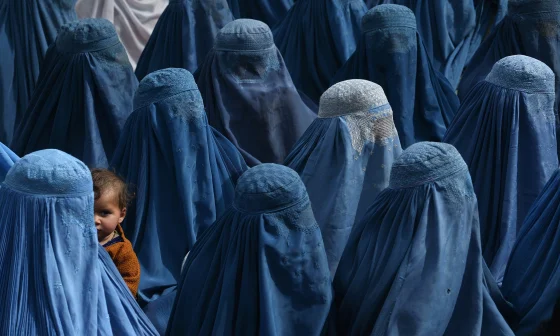

Law Allows Abuse Without “Broken Bones”
The Taliban leadership in Afghanistan has formally enacted a new 90-page penal code that legalises domestic violence under specific conditions. The document was signed by Supreme Leader Hibatullah Akhundzada and made public in late January 2026.
The new law grants husbands the legal right to physically punish their wives and children, provided the violence does not result in “broken bones or open wounds.” Critics say the regulation severely undermines women’s rights and autonomy.
Under the code, even in cases of serious injury, penalties remain minimal. A husband found responsible for severe physical trauma may face a maximum of 15 days in prison. Rights groups say this effectively shields abusers from meaningful accountability.
The burden of proof lies entirely on the victim. Women must provide evidence of abuse in court. Afghan court procedures require women to be fully covered and accompanied by a male guardian. In many cases, the guardian is the alleged abuser, making justice nearly impossible.
The law also imposes a three-month prison sentence on married women who visit relatives without their husband’s permission. Observers say this provision further restricts women’s freedom of movement.
Four-Tier “Caste System” Replaces Legal Equality
Article 9 of the new penal code abandons the principle of equality before the law. It introduces a four-tier system where punishment depends on social rank rather than the severity of the crime.
Religious scholars, referred to as Ulama, are subject only to advice or verbal warning. Tribal elders and elites may receive a formal court summons and advice. The middle class faces imprisonment. The lower class can face threats, imprisonment, or corporal punishment.
Human rights advocates describe this system as institutionalised discrimination. Article 15 of the code also references “free” and “enslaved” persons. Legal experts say this contradicts the global ban on slavery and servitude.
Afghan-led human rights organisation Rawadari reported widespread fear among citizens. The group stated that even discussing the penal code could be treated as a criminal offense under Taliban rule.
Vigilante Powers and Global Outcry
The new decree authorises so-called “vigilante justice.” Citizens who witness a perceived moral violation can impose “ta’zir” punishment on the spot to prevent vice. Critics warn this provision may encourage arbitrary violence and abuse.
The law has also drawn attention for placing stricter penalties on animal cruelty than on domestic abuse. Article 70 mandates five months in prison for forcing animals or birds to fight. In contrast, domestic violence may result in only 15 days behind bars.
Reem Alsalem, the UN Special Rapporteur on violence against women, described the implications as “terrifying.” She questioned whether the international community would intervene.
Observers say the code marks a further rollback of women’s rights in Afghanistan. Since returning to power, the Taliban have introduced sweeping restrictions on women’s education, employment, and public life.
The newly enacted penal code is seen as a significant shift in Afghanistan’s legal framework. Rights groups argue it institutionalises inequality and weakens legal protections for women and vulnerable communities.
