

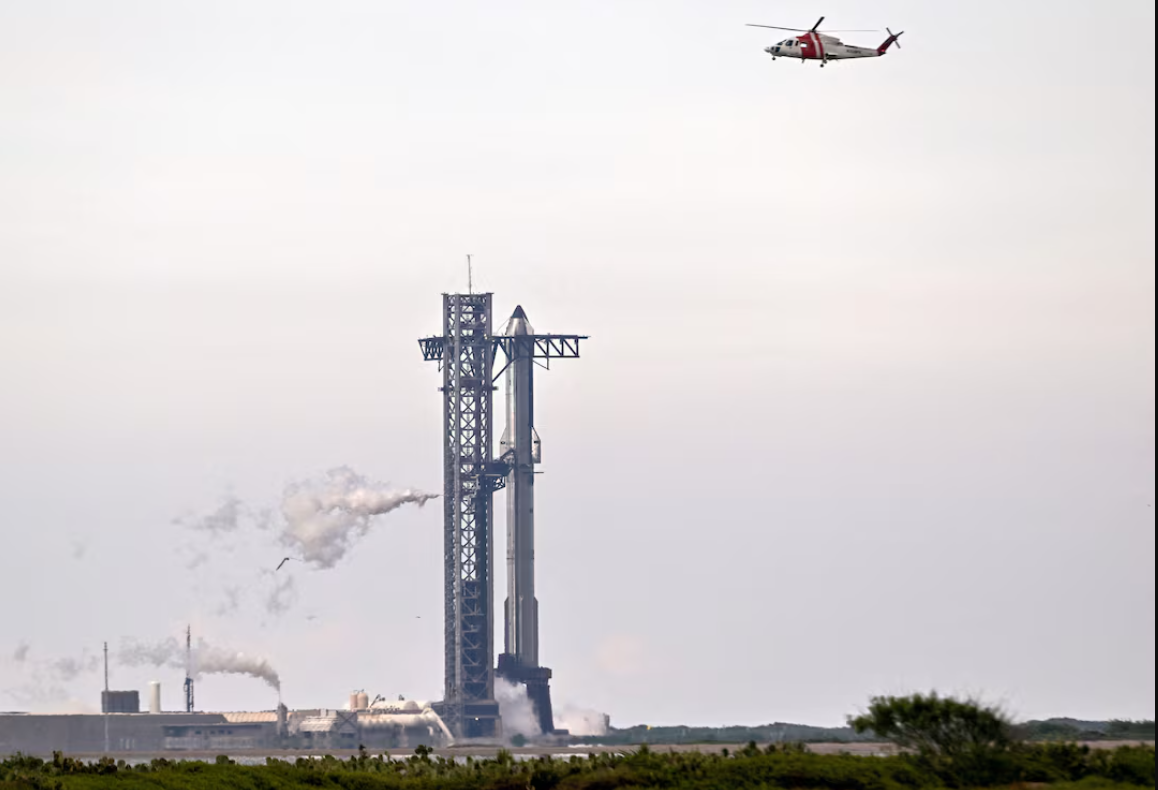

SpaceX postponed the tenth Starship test flight from its Starbase facility in Texas on Sunday. The delay occurred due to an issue with ground systems, forcing engineers to troubleshoot before liftoff.
The Super Heavy booster, standing 232 feet tall, was paired with the 171-foot Starship upper stage on the launch mount. Propellant loading had begun ahead of the planned 7:35 pm launch. However, approximately 30 minutes before liftoff, SpaceX announced the stand-down to address the technical issue safely.
Elon Musk had planned to provide a development update during the launch, but the live stream was canceled due to the postponement. Historically, similar delays at Starbase have been resolved within a few days. SpaceX now aims for the next launch attempt as soon as Monday, August 25.
Development Challenges and Milestones
Starship’s development has faced repeated challenges this year. Early flight tests of Starship ended in failures, and the ninth test mission also encountered issues. In June, a test stand explosion sent debris into neighboring Mexican territory, highlighting the risks inherent in SpaceX’s test-to-failure approach.
Despite these setbacks, the company continues to manufacture Starship prototypes rapidly at its Starbase production facilities. NASA plans to use Starship for its first crewed Moon mission since the Apollo program, potentially as early as 2027.
Starship’s Technical Features
The current iteration of Starship includes significant upgrades. These features include enhanced thrust, a more resilient heat shield, and stronger steering flaps. These improvements are crucial for atmospheric reentry and achieving rapid reusability, a central goal for Musk’s Mars ambitions.
The Super Heavy booster, which has successfully landed using mechanical arms in prior tests, was scheduled to target a soft water landing in the Gulf of Mexico. Meanwhile, Starship’s upper stage was to ignite its engines for a brief suborbital flight, release mock Starlink satellites, and then test engine reignition in space.
Reentry Testing and Safety
After the suborbital phase, Starship was expected to perform an atmospheric reentry over the Indian Ocean. This phase tests prototype heat shield tiles and engine flaps under extreme temperatures, replicating conditions that previously damaged the rocket’s exterior.
SpaceX has designed the reentry profile to intentionally stress the upper stage’s rear flaps at maximum dynamic pressure. This testing is essential to validate Starship’s durability and its potential for repeated missions.
The delay highlights the complexities of launching a next-generation rocket like Starship. Nonetheless, SpaceX remains committed to rapid testing and iterative improvements. The upcoming launch will determine the success of new technical upgrades and move Starship closer to operational readiness for orbital missions and future space exploration goals.
