

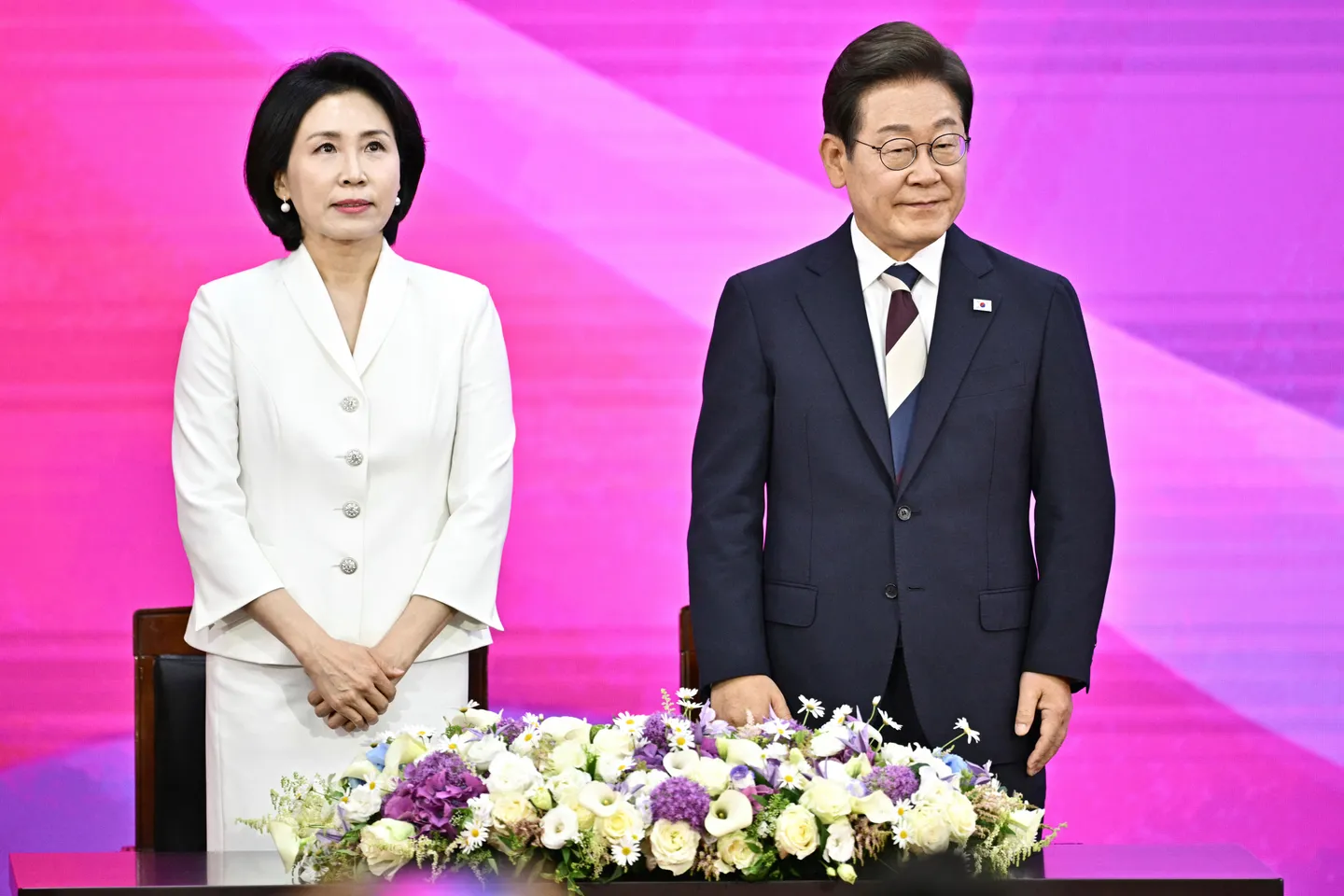

South Korea’s newly elected President Lee Jae-myung was officially sworn in on Wednesday following a landmark victory in a snap election. In his inaugural speech, Lee outlined a balanced foreign policy agenda—committing to robust defense through the South Korea-U.S. alliance while keeping the door open for renewed dialogue with North Korea.
“Our government will pursue strong deterrence against North Korean threats through the South Korea-U.S. alliance,” Lee said, “but we will also leave room for dialogue to achieve lasting peace on the Korean Peninsula.”
Underscoring a pragmatic and balanced foreign policy, Lee emphasized deeper trilateral cooperation with the United States and Japan, pledging to reinforce regional stability through closer ties with both allies.
On the domestic front, Lee vowed to steer South Korea toward a renewable energy-driven economy and push forward reforms aimed at tackling economic inequality and a worsening demographic crisis.
Economic Headwinds and Trade Tensions
Lee assumes office amid rising economic challenges, particularly heightened trade tensions with the United States. Under expanded trade policies introduced by U.S. President Donald Trump, South Korean steel and aluminum exports now face 50% tariffs—a serious concern for a country that ranked as the fourth-largest exporter of steel to the U.S. last year.
While acknowledging the urgency of the matter, Lee has indicated that there is “no need to rush” into a trade deal, especially as his administration transitions into power. He stressed the importance of analyzing how other major economies like Japan and China are managing their negotiations with Washington.
“In today’s rapidly changing global landscape, marked by growing protectionism, we will pursue diplomacy grounded in realism and national interest,” Lee stated.
A Shift in North Korea Policy
Lee’s approach to Pyongyang signals a departure from the hardline stance taken by his predecessor, Yoon Suk-yeol, under whom inter-Korean relations deteriorated sharply.
Though his Democratic Party has historically favored engagement, Lee clarified that he will combine military readiness with diplomatic outreach in handling North Korea.
“We will heal the scars of division and war, and work toward a future of peace and shared prosperity,” he said. “Peace, no matter how costly, is still better than war.”
Tensions remain high as North Korea has officially labeled the South an “enemy state” and strengthened its military cooperation with Russia, including the reported deployment of thousands of troops to support Moscow’s invasion of Ukraine.
