

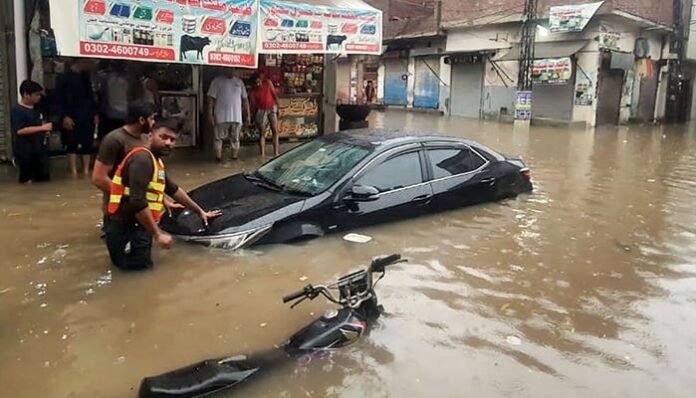

Heavy monsoon rains lashed Lahore on Saturday, bringing the city to a standstill as major roads were submerged, traffic ground to a halt, and at least six people lost their lives in separate weather-related incidents. The torrential downpour, the heaviest of the season so far, overwhelmed the city’s infrastructure and exposed the vulnerabilities of its drainage system. Officials from the Water and Sanitation Agency (WASA) confirmed record-high rainfall in several areas, intensifying concerns about urban flooding.
Rescue officials reported multiple casualties across different parts of the city. In Kahna, lightning struck during the storm, killing two people and injuring two others. The injured were immediately rushed to a nearby hospital for medical treatment.
In another tragic incident in Old Anarkali, the roof of a mud-and-T girder house collapsed under the pressure of the downpour, claiming the life of a man. Rescue workers from the Urban Search and Rescue team worked for hours before finally recovering the body from the debris.
A similar tragedy unfolded on Bedian Road, where the roof of a house caved in, killing three people and leaving four others injured. Rescue teams managed to retrieve the injured and transport them to nearby hospitals. These fatal incidents underscored the deadly impact of the rains on vulnerable housing structures across the city.
Beyond the human toll, the rain wreaked havoc on Lahore’s transportation network. An hour-long spell of heavy showers turned key arteries — including Johar Town, Wapda Town, Gulberg, Ferozepur Road, Canal Road, and Muslim Town — into waterlogged stretches resembling rivers.
Vehicular movement slowed to a crawl, while many residents reported being stranded due to traffic jams and water accumulation. The situation was further exacerbated by widespread power outages across several localities, with many residents describing the city as “paralysed” under the weight of the monsoon.
WASA released detailed statistics highlighting the scale of the downpour. Nishtar Town recorded the highest rainfall at 145 mm, followed by Chowk Nakhda with 117 mm and Tajpura with 116 mm. Other localities such as Upper Mall (107 mm), Iqbal Town (106 mm), and Laxmi Chowk (102 mm) also saw alarming levels of rainfall within a short span of time.
The Meteorological Department warned that the heavy rains were not yet over. Deputy Director Irfan Virk stated that the current spell would continue intermittently for the next 24 hours. He further cautioned that another monsoon system is expected to enter Pakistan during the first week of September, potentially intensifying the risk of urban flooding.
So far, Pakistan has already received 12 percent more rainfall than the seasonal average, raising alarms about the growing threat of climate-driven weather extremes and the need for urgent urban resilience measures in cities like Lahore.
