

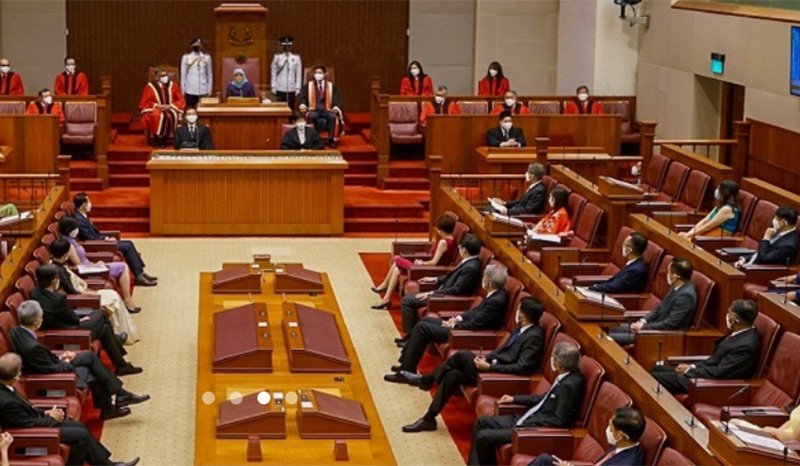

Singapore’s parliament was officially dissolved on Tuesday, paving the way for a general election to be held within the next three months, according to a government gazette.
This will be the first electoral test for Prime Minister Lawrence Wong, who succeeded long-serving leader Lee Hsien Loong as head of the ruling People’s Action Party (PAP) in May 2024.
While the PAP is widely expected to retain its dominant position—as it has in every election since Singapore’s independence in 1965—analysts will closely scrutinize the party’s share of the popular vote following its relatively weak performance in the 2020 polls.
The election comes at a time of mounting economic uncertainty. Singapore’s trade-dependent economy is facing headwinds from renewed U.S. tariffs under President Donald Trump, prompting the government to revise its 2025 GDP growth forecast down to 0%–2% from an earlier estimate of 1%–3%.
Recent years have seen the ruling party’s popularity wane slightly, with the opposition steadily gaining ground. The Workers’ Party made historic gains in previous elections, securing 6 parliamentary seats in both 2011 and 2015, and 10 in the 2020 vote.
The upcoming election will see voters choose 97 lawmakers—four more than in 2020—across 15 single-member constituencies and 18 group representation constituencies, each electing four or five members.
In February, PM Wong unveiled what many analysts described as a “full-blown election budget,” featuring broad-based financial incentives and support measures for citizens in the lead-up to the polls.
