


By Aamir Latif
KARACHI: The sharp clang of hammers echoes through a deserted compound in Lyari, one of Karachi’s oldest neighborhoods, as laborers dismantle what remains of a collapsed five-story building. The tragedy, which claimed 27 lives and injured many more, has left dozens homeless and cast a spotlight on the city’s crumbling infrastructure and widening housing crisis. Most of the victims belonged to the Hindu community.
Once a vital part of daily life for multiple families, the building stood on a pothole-riddled street in Pakistan’s commercial capital. Its sudden collapse followed decades of neglect and structural decay.
“It felt like a bomb went off above me,” said Rashid Ali, who survived a fall from the rooftop with a fractured leg. “I remember people screaming and pulling me from the rubble.”
Another resident, Chaman Meshuri, recalled feeling two strong jolts before the building gave way. His quick action to evacuate saved his five children, but four other family members did not make it out in time.
Initial investigations reveal the building was originally approved for three floors but was illegally extended by two additional stories. It had been declared unsafe in 2022, but instead of enforcing an evacuation, the building’s owner allegedly worked with local authorities to make unlawful structural additions. Residents like Ali and Meshuri say they were never informed of any evacuation orders.
Unsafe Structures: Shaky old buildings become ticking bombs
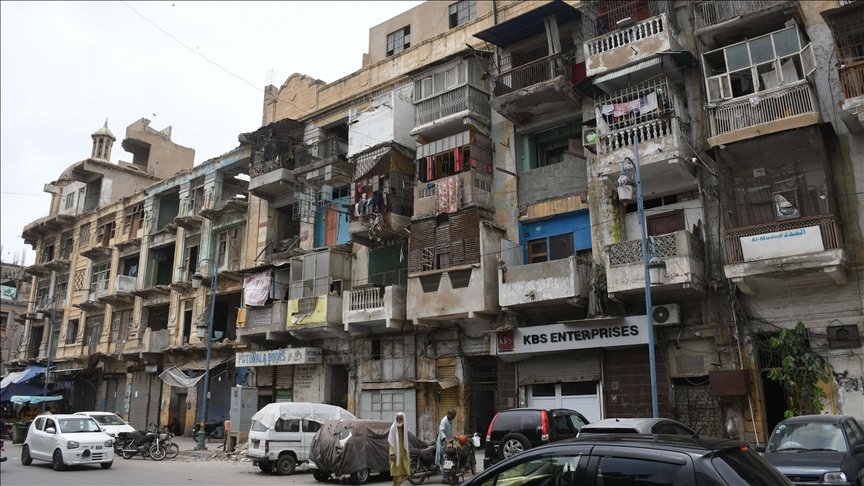
Lyari, a densely populated area near the Arabian Sea, is home to hundreds of aging, hazardous buildings. Over 1,500 structures from the British colonial era still stand—many listed as protected heritage—but a large number are dangerously dilapidated.
City planning expert Arif Hasan warns that approximately 600 buildings across Karachi are structurally unsound, with at least 50 in “extremely dangerous” condition.
“These buildings are like ticking bombs,” Hasan said. “One strong tremor could bring widespread disaster. Corruption, illegal construction, and lack of oversight are turning Karachi into a deathtrap.”
Many of these old buildings house tenants paying nominal rent rates frozen since the 1947 partition, between PKR 150 and 250 ($0.60–$0.80), discouraging both owners and tenants from investing in maintenance. Ironically, some of the pre-Partition structures are now more stable than newer, poorly constructed ones.
A Housing Crisis with Deadly Consequences
Building collapses are not new in Karachi. In 2020, a similar incident in Golimar killed 27 and injured more than 50. Poor regulatory enforcement means even recently built structures remain vulnerable.
Hasan stresses that Karachi’s unchecked housing shortage is driving low-income residents into the arms of unregulated developers.
“Without affordable housing, people will continue to fall prey to unsafe construction. We need a long-term urban housing strategy,” he said.
Hassan Bakhshi, chairman of the Association of Builders and Developers (ABAD), echoed this sentiment and offered the association’s help in rebuilding dangerous structures.
“These buildings are a threat not only to their residents but also to the surrounding community. They must be demolished and rebuilt with proper seismic and safety standards,” Bakhshi urged.
He called for the creation of an independent authority comprising developers, engineers, and planners to spearhead the city’s reconstruction efforts, noting that most residents lack the financial means to rebuild without state support.
Government Response and Accountability
In response to the tragedy, the Sindh government has directed the Sindh Building Control Authority (SBCA) to vacate and demolish structures deemed “highly dangerous.” A spokesperson confirmed that notices have been issued to residents of about 50 such buildings.
“Evacuation is extremely difficult. People resist because they demand alternate housing, which is beyond our mandate,” the SBCA official said anonymously.
The SBCA has also acknowledged its own lapses in allowing illegal floors to be constructed on the collapsed Lyari building. Eight SBCA officials and the building’s owner have been arrested, and an investigation is ongoing.
Sindh Minister Sharjeel Memon conceded that the government lacks the capacity to relocate all residents of unsafe buildings.
“We will try to accommodate the most vulnerable with whatever resources are available,” he said. “But legally, we are not obligated to provide housing.”
The Lyari collapse has once again highlighted Karachi’s deteriorating urban landscape, where outdated infrastructure, corruption, and an exploding population continue to collide with deadly consequences. Courtesy: Aamir Latif/Anadolu Agency
