
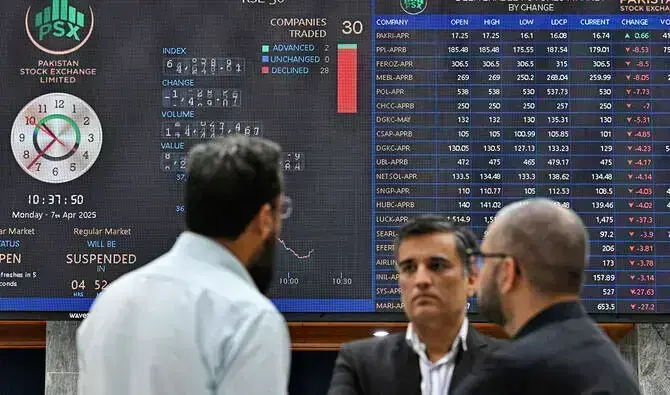

Karachi — Selling pressure gripped the Pakistan Stock Exchange (PSX) on Thursday as escalating geopolitical tensions in the Middle East rattled investor sentiment. Consequently, the benchmark KSE-100 Index dropped more than 1,000 points within minutes of the opening bell.
At 9:25am, the KSE-100 Index stood at 154,812.88 points, showing a decline of 1,045.59 points or 0.67 percent. Investors rushed to offload shares across several major sectors as uncertainty over global energy markets and regional security intensified.
Broad-based selling across key sectors
Heavy selling appeared in multiple sectors, including automobile assemblers, cement, commercial banks, fertilizer, oil and gas exploration companies, oil marketing firms, power generation, and refineries. As a result, several index-heavy stocks traded in negative territory.
Among the major laggards were Attock Refinery Limited (ARL), Hub Power Company (HUBCO), Mari Petroleum (MARI), Oil and Gas Development Company (OGDC), Pakistan Petroleum Limited (PPL), MCB Bank (MCB), Meezan Bank (MEBL), and National Bank of Pakistan (NBP). The widespread decline reflected investor caution amid rising global uncertainties.
Meanwhile, Pakistan and the International Monetary Fund (IMF) reported progress in talks regarding the third review of the country’s Extended Fund Facility programme. IMF mission chief Iva Petrova stated on Wednesday that discussions had made considerable progress, although negotiations would continue to assess the economic impact of recent global developments.
Global markets slide as oil prices surge
International markets also faced pressure as geopolitical risks pushed oil prices sharply higher. Reports of attacks on ships near the Strait of Hormuz and Iraqi waters heightened fears of supply disruptions in the region.
Consequently, US crude prices jumped 7.5 percent to $93.80 per barrel, while Brent crude surged 7.7 percent to $99.03 per barrel. Although the International Energy Agency announced plans to release 400 million barrels from strategic reserves, markets remained volatile.
Meanwhile, Asian stocks declined, with MSCI’s Asia-Pacific index outside Japan falling 0.8 percent and Japan’s Nikkei dropping 1.6 percent.

