


North Sea Collision
The UK coastguard has officially ended the search for a missing crew member following a collision between a cargo ship and a US-military-chartered tanker carrying jet fuel in the North Sea. The incident occurred on Monday when the container vessel Solong struck the Stena Immaculate tanker approximately 10 miles (16 kilometers) off the east coast of England near Hull.
Following the collision, HM Coastguard launched a large-scale rescue operation, successfully saving 36 crew members from both vessels. One individual was taken to the hospital for treatment, while another crew member from the Solong remains unaccounted for. Despite an extensive search effort, officials confirmed that the missing crew member was not found, and the operation was called off.
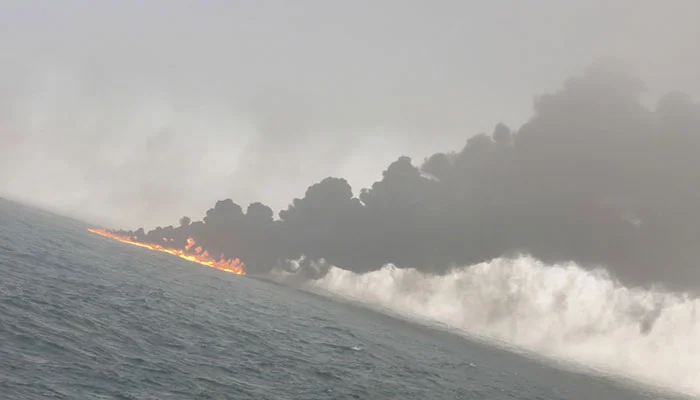
Images from the scene showed thick black smoke and flames engulfing parts of the ships, raising concerns about environmental and health hazards due to the cargo they were carrying. The Stena Immaculate, which was on a short-term US military charter with Military Sealift Command, had been transporting around 220,000 barrels of A1 jet fuel.
The collision ruptured part of the tanker, leading to a fire and fuel leakage. Additionally, the Solong was carrying 15 containers of sodium cyanide, a highly toxic substance. While it remains unclear whether any of the chemical was released, the potential risks have alarmed environmental experts and marine conservationists.
The fire continued to burn on both vessels for more than 12 hours after the collision. The UK government expressed deep concern over the incident, with Prime Minister Keir Starmer’s spokesperson calling the situation “extremely concerning.” The Marine Accident Investigation Branch has dispatched a team of inspectors to gather evidence and conduct a preliminary assessment of the accident.
Environmental experts have voiced serious concerns about the potential impact on marine life. Paul Johnston, a senior scientist at Greenpeace Research Laboratories, warned of “multiple toxic hazards” due to the chemicals on board. He emphasized that jet fuel entering the water near a breeding ground for harbor porpoises could have devastating effects.
Sodium cyanide, if leaked, poses a severe threat as it is highly toxic and could cause significant harm to marine ecosystems. However, Ivor Vince, founder of ASK Consultants, an environmental risk advisory firm, noted that jet fuel is not as persistent as crude oil and is likely to evaporate or degrade quickly, although it will still have immediate harmful effects on aquatic life.
In response to the incident, vessel movements in the Humber estuary, which leads into the North Sea, have been suspended by Associated British Ports (ABP) as a safety precaution. Meanwhile, Germany’s Central Command for Maritime Emergencies has dispatched a vessel equipped for firefighting and oil recovery to assist in managing the situation.
The alarm about the collision was raised at 0948 GMT, prompting a swift response from emergency services. A coordinated rescue effort included a coastguard helicopter, a surveillance plane, lifeboats from four different towns, and nearby vessels assisting in search and rescue operations.
Local residents and maritime professionals have expressed shock at the incident. Paul Lancaster, a former seaman from Grimsby, questioned how such a collision could have happened, speculating that a major engineering failure must have been involved.
Although collisions in the North Sea are rare, similar incidents have occurred in the past. In October 2023, two cargo ships, Verity and Polesie, collided near Germany’s Heligoland islands, resulting in three deaths and two missing crew members who were later presumed dead.
Another serious incident occurred in October 2015 when the freighter Flinterstar sank after colliding with the Al Oraiq tanker off the Belgian coast while carrying large quantities of fuel.
As investigations into the latest collision continue, authorities are working to assess the damage, determine the cause of the accident, and evaluate potential environmental consequences. The focus remains on ensuring maritime safety and preventing future disasters in the busy waters of the North Sea.
