

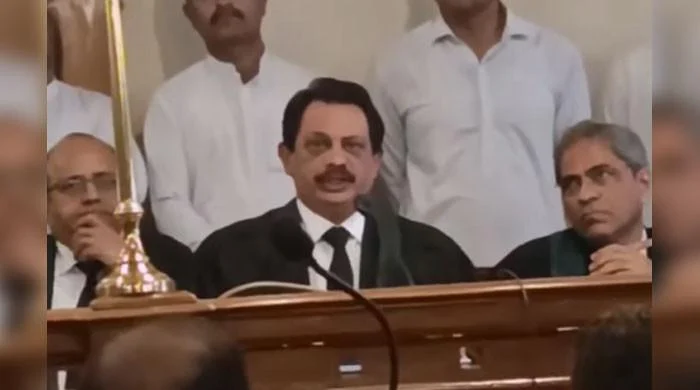

UMERKOT: Supreme Court Justice Salahuddin Panhwar delivered a scathing critique of Pakistan’s judicial and law enforcement systems during a speech at the Umerkot Bar Association’s oath-taking ceremony on Friday. He openly condemned the role of dishonest judges, lawyers, and police officers in contributing to delayed justice and erosion of public trust in the legal system.
Justice Panhwar lamented that the justice system has become dysfunctional in many areas, failing to serve the public effectively. Referring to the famous legal maxim, “Justice delayed is justice denied,” he said, “A court that cannot deliver justice is meaningless.” He highlighted heartbreaking examples of extreme delays, such as a woman who waited 71 years for a ruling in an inheritance case and another individual whose accident case was resolved after 24 years.
Condemns Judicial Compromise and Misuse of Law
Justice Panhwar criticized feudal and bureaucratic influence in legal proceedings, warning that some judges have compromised their integrity to appease the powerful. “Judges must act with courage and not fear,” he said, adding that breaking the judicial oath leads to the collapse of public confidence.
Referring to the murder case of journalist Nasrullah Gadani, he expressed alarm that lawyers, police, and even judges were defending the accused. He also condemned the misuse of laws like the Dispossession Act, originally intended to protect the poor, but now reportedly used to harass them.
He questioned the priorities of judicial officers, asking: “Whose judges are we—people’s or the elite’s?”
Systemic Decay and Social Failures
Justice Panhwar did not shy away from pointing out wider societal hypocrisy, where virtue is preached but rarely practiced. “Sometimes I wonder whether we are judges or bandits,” he remarked, calling for judges to engage with communities and understand how ordinary people live.
He addressed the issue of “forced conversions”, noting that 90% of runaway girls belonged to Muslim families, not minorities—highlighting broader failures in protecting women. He also expressed concern about the lack of shelters and education for vulnerable women, especially among marginalised communities like scheduled castes.
Panhwar criticised superficial handling of cases, citing the example of Mirpurkhas courts, which cleared 319 out of 320 cases in just a week, implying that speed had replaced substance in judicial proceedings.
Law Enforcement Under Fire
Justice Panhwar also came down hard on police inefficiency, accusing Umerkot police of focusing on extortion rather than fighting crime. He noted that under a particular sessions judge, crime increased rather than decreased.
He cited a conversation with a Sukkur SSP, who confessed to being helpless in controlling crime. Justice Panhwar said he told the officer: “If we can’t act, we should resign and go home.”
He also criticised the misuse of the Cooperative Housing Society Act, saying it was designed to empower farmers and labourers, not to fuel commercial housing schemes.
A Stark Warning
Concluding his address, Justice Panhwar warned that unless drastic reforms are made, the system is at risk of total collapse. “Our rulers lie, our institutions lie, and even the people have stopped speaking the truth. If we don’t change ourselves, the system will fall apart,” he said.
The event was attended by several prominent legal figures, including Justice Jan Ali Junejo of Sindh High Court, Tharparkar Sessions Judge Abdul Waheed Sheikh, Umerkot Sessions Judge Abdul Qudoos Memon, Advocate Yousif Laghari, and representatives from the Sindh High Court Bar Association and Sindh Bar Council.
