

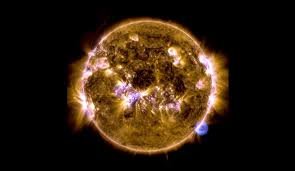

NASA’s Parker Solar Probe has made a groundbreaking discovery during a daring plunge through the Sun’s atmosphere, capturing direct evidence of a massive magnetic explosion that defied expectations.
During its recent pass through the solar corona—the outermost layer of the Sun’s atmosphere—the probe recorded a dramatic plasma jet shooting toward the Sun’s surface, rather than away from it. Even more surprising were the protons it detected, carrying energy levels nearly 1,000 times higher than anticipated.
According to Live Science, the Parker Solar Probe was ideally positioned between the Sun and the origin point of these high-energy particles, allowing scientists to trace their source with remarkable clarity.
This rare and powerful event is the result of magnetic reconnection, a process where tangled magnetic field lines suddenly snap apart and reconnect. This explosive reconfiguration unleashes massive amounts of stored magnetic energy, which accelerates particles to extraordinary speeds and drives the solar wind—a continuous stream of charged particles flowing from the Sun across the solar system.
What sets this observation apart is the direction and intensity of the explosion. Plasma jets typically move outward into space, but this one surged inward, revealing new insights into how the Sun’s dynamic magnetic field behaves. It also suggests the Sun’s magnetism can accelerate particles far more efficiently than scientists had previously calculated.
Understanding magnetic reconnection is critical for improving forecasts of space weather—a term describing the impact of solar activity on Earth and beyond. Space weather affects everything from satellite functionality and GPS accuracy to astronaut safety and terrestrial power grids. In extreme cases, it can trigger geomagnetic storms capable of disrupting communications and damaging infrastructure.
On a broader scale, space weather has also shaped planetary evolution. Mars, for instance, is believed to have lost much of its atmosphere due to solar wind stripping it away over time—transforming it from a potentially habitable world into the frozen desert we see today.
The Parker Solar Probe continues to break barriers in solar science. As the first spacecraft to fly through the Sun’s corona, it carries instruments designed to capture precise measurements of magnetic fields, particles, and solar wind conditions. Its mission is shedding new light on the heliosphere, the vast bubble of solar influence that surrounds our entire solar system.
This latest discovery is a powerful reminder of the Sun’s raw, unpredictable energy—and the need to understand it better as we venture further into space.
