

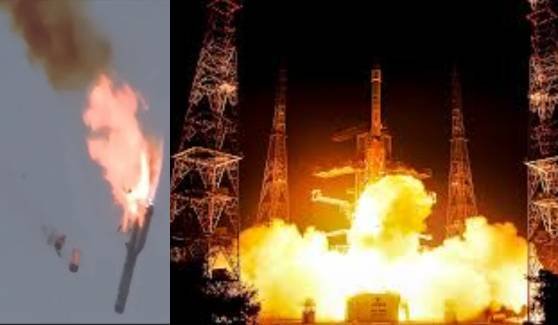

India’s efforts to expand its remote sensing capabilities encountered a major setback early Sunday when an Earth-observation satellite failed to reach orbit due to a launch failure from the Satish Dhawan Space Centre.
The Indian Space Research Organisation (ISRO) launched the EOS-09 satellite aboard its Polar Satellite Launch Vehicle (PSLV) on Saturday at 8:29 p.m. EDT (0029 GMT or 5:59 a.m. IST on Sunday, May 18). However, the mission was unsuccessful after a malfunction in the rocket’s third stage, approximately six minutes into the flight, prevented the satellite from reaching its designated orbit.
ISRO Chairman V. Narayanan stated in a televised address that the PSLV performed as expected during the first two stages of the launch. “The third stage motor ignited normally, but during its operation, we observed an anomaly which caused the mission to fail,” he explained, noting that a detailed investigation is underway.
Telemetry data showed a loss in velocity and deviation from the intended flight path during the third stage burn. ISRO later confirmed a drop in chamber pressure in the third stage as the cause of the failure, which led to the satellite not achieving orbit.
This failure marks the PSLV’s first since August 2017, when a navigation satellite mission failed due to a fairing separation issue. Before that, the PSLV experienced setbacks during its debut in 1993 and another partial failure in 1997.
EOS-09, weighing 1,694 kilograms (around 3,735 pounds), was equipped with synthetic aperture radar (SAR) to capture high-resolution images under all weather conditions, day or night. It was intended to be deployed into a sun-synchronous orbit at an altitude of 535 kilometers, 18 minutes after liftoff.
Had the mission succeeded, EOS-09 would have been the ninth satellite in India’s Earth Observation Satellite series. The satellite was structurally similar to EOS-04, launched successfully in 2022.
According to ISRO, EOS-09 was built to provide continuous remote sensing data for a variety of operational applications. Though no detailed objectives were shared, Indian media suggested the satellite would have supported strategic surveillance along the country’s borders with Pakistan and China. Outlets had described its 24/7 imaging capabilities as particularly valuable in the context of national security.
The PSLV, regarded as the cornerstone of India’s space programme, has executed over 60 missions since its first launch in the 1990s. Despite its reputation for reliability, Saturday’s incident underscores the inherent risks of space exploration.
This was the PSLV’s first mission of 2025, following a consistent record of three launches annually over the past three years.
