

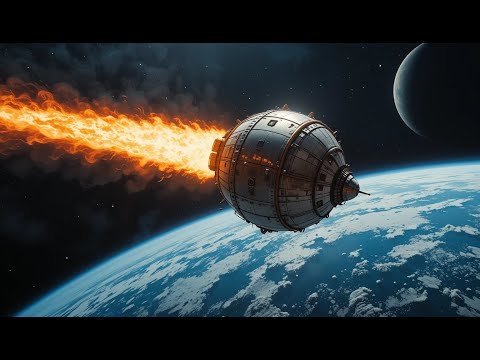

Soviet Lander
The long journey of the failed Soviet Venus lander, Kosmos 482, has come to an end after more than five decades in space. The spacecraft, which had been orbiting Earth since 1972, finally crashed into our planet’s atmosphere on Saturday, concluding a remarkable but troubled mission.
According to Roscosmos, Russia’s space agency, the spacecraft reentered Earth’s atmosphere over the Indian Ocean, just west of Jakarta, Indonesia, at around 2:24 AM ET (0624 GMT or 9:24 AM Moscow time). Early estimates suggest that Kosmos 482 fell into the sea without causing any harm, but the exact location remains uncertain.
While Roscosmos provided one possible reentry point, other space agencies and tracking organizations projected reentry points ranging from the eastern Pacific Ocean to the South Asian peninsula. As of now, there is no confirmed information regarding where exactly the probe ended up, leaving the mystery of its final resting place unsolved.
Before its dramatic return, the spacecraft passed over Rome, Italy, early on May 10, just before daybreak. Gianluca Masi, an astronomer with the Virtual Telescope Project, managed to capture an image of the spacecraft during one of its last orbits.
In the photograph, Kosmos 482 appears as a dashed trail entering from the top of the frame, a result of combining four individual images to capture its fleeting path. This image provided one of the final glimpses of the Soviet probe as it sailed through the night sky.
Kosmos 482 was originally part of the Soviet Union’s ambitious Venera program, which, throughout the 1960s, 1970s, and early 1980s, sent numerous probes to Venus in an effort to explore Earth’s neighboring, sweltering planet.
Kosmos 482, launched in 1972, was intended to land on Venus, but a malfunction during the launch left the spacecraft in an elliptical orbit around Earth instead. The spacecraft’s gradual descent, caused by atmospheric drag, led to its eventual reentry after a lengthy 53-year orbit.
Unlike most space debris, which burns up upon reentry, large objects like rocket bodies and decaying satellites typically break apart, creating bright meteor showers visible from Earth. However, Kosmos 482’s crash did not result in any major celestial display, and it appears to have safely fallen into the ocean, with no reported damage or injuries.
The end of Kosmos 482’s journey marks the conclusion of a mission that spanned over half a century, reflecting the unpredictable and often lengthy fates of space missions.
While it failed in its original goal to reach Venus, the spacecraft’s extraordinary longevity offers a fascinating reminder of the resilience and enduring legacy of space exploration, even for missions that didn’t go quite as planned.
