

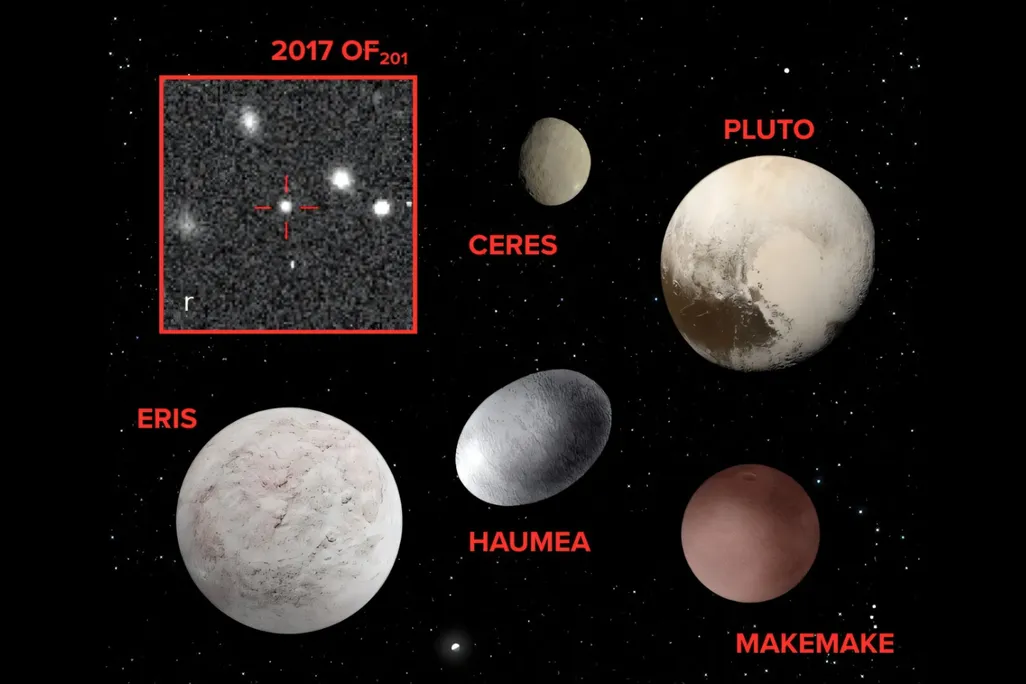

Rare Celestial Body
WASHINGTON: Scientists have identified a rare and distant object in our solar system, far beyond the orbit of Neptune, in a region considered among the coldest and least explored.
The object, named 2017 OF201, is believed to be an icy body that may be large enough to qualify as a dwarf planet, based on its estimated size and characteristics.
What makes this celestial body especially intriguing is its extremely long orbit—it takes nearly 25,000 years to complete just one trip around the Sun. Currently, 2017 OF201 is situated 90.5 astronomical units (AU) from the Sun—about 90 times farther than Earth. At its farthest point, it travels beyond 1,600 AU, making it one of the most distant objects ever observed in the solar system.
The object belongs to a class known as trans-Neptunian objects (TNOs), which orbit the Sun at distances greater than Neptune. It lies in a largely unexplored zone beyond the Kuiper Belt, a region populated by icy bodies and remnants from the solar system’s formation.
The discovery of 2017 OF201 suggests that this vast space may not be as empty as once believed, and hints at the possible existence of many other such hidden objects.
Identified through seven years of telescope observations in Chile and Hawaii, the object is estimated to be slightly smaller than Ceres, the smallest known dwarf planet. While its exact shape and composition remain unknown due to its distance, scientists believe it is made of ice, similar to other TNOs.
Astrophysicist Sihao Cheng from the Institute for Advanced Study in Princeton, who co-led the research, said that the object’s wide and eccentric orbit suggests a turbulent past—possibly influenced by gravitational interactions with a giant planet.
This discovery also holds implications for the Planet Nine hypothesis, which posits the existence of a ninth planet affecting the orbits of distant TNOs. Cheng noted that 2017 OF201 does not follow the orbital clustering pattern expected if Planet Nine exists, potentially challenging the theory.
The discovery was announced by the Minor Planet Center of the International Astronomical Union and detailed in a preprint study posted to arXiv, though it has not yet undergone peer review.
Researchers estimate there could be hundreds of similar objects with extreme orbits still undetected due to the limitations of current telescopic technology. As our tools improve, more distant members of our solar system may come to light, reshaping our understanding of its structure and history.
