

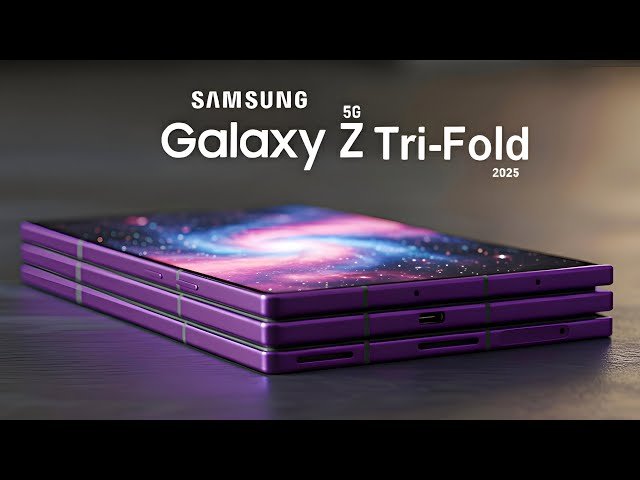

Samsung’s highly anticipated Galaxy Z Tri-Fold will officially debut on December 5, marking a significant milestone in foldable smartphone innovation. However, this launch represents a calculated strategy rather than a traditional product rollout, with availability severely limited to gauge market response and product durability.
Conservative Design Philosophy: Dual-Inward Fold System
Samsung has made a deliberate engineering choice that prioritizes durability over sleekness with its “Dual-Inward” or G-Shape folding mechanism.
Protection-First Approach
Unlike the Huawei Mate XT’s Z-Fold design that leaves one screen panel exposed, Samsung’s tri-fold device features both side panels folding inward to completely protect the main 10-inch flexible display. This design requires a separate fourth glass display on the outer cover, increasing the folded thickness to approximately 14mm.
While competitors like Huawei achieved thinner profiles by leaving portions of the flexible screen exposed, Samsung prioritizes screen protection. When closed, the expensive plastic display remains shielded behind the metal chassis, addressing the primary consumer concern about scratching vulnerable foldable screens.
This conservative engineering choice may result in a bulkier device, but it offers peace of mind—a trade-off Samsung believes consumers will accept for their premium investment.
Limited Production Strategy: A “Public Beta” Launch
Samsung’s approach to the Galaxy Z Tri-Fold launch differs dramatically from typical flagship releases.
Restricted Availability
Initial production is capped at just 50,000 to 100,000 units, exclusively available in South Korea with limited distribution through select Chinese retailers. Western markets, including the United States and Europe, are notably absent from this launch phase.
For perspective, Samsung typically manufactures millions of Galaxy S series devices for launch day. This scarcity is intentional and strategic.
Manufacturing Challenges
Creating displays that successfully fold at two separate points simultaneously presents exponentially greater complexity than standard foldables. Current yield rates—the percentage of screens manufactured without defects—remain low. Limited production allows Samsung to manage constrained inventory without disappointing major carriers expecting millions of units.
Real-World Testing Ground
By concentrating the launch in South Korea and potentially China, Samsung keeps its test population geographically contained. If hinge defects emerge after months of actual usage, recalling 50,000 units domestically is manageable. Recalling millions across global markets could trigger a brand crisis reminiscent of the Galaxy Note 7 incident.
Essentially, early Korean adopters paying approximately $3,000 are functioning as paid beta testers. Data collected from this December launch will directly inform the global version anticipated in late 2026.
Import Considerations for International Buyers
Tech enthusiasts considering importing the Galaxy Z Tri-Fold through specialized retailers face several critical limitations:
Connectivity Concerns
The Korean model (likely SM-F966N) is optimized for Asian 5G frequency bands. While it should support basic US LTE connectivity, it may lack specific mmWave bands utilized by carriers like Verizon and AT&T for high-speed 5G. Buyers could end up with a $3,500 device limited to 4G speeds.
Software and Service Restrictions
Imported Samsung devices frequently feature region-locked functionality. Samsung Pay and digital wallet services may refuse US credit cards, while certain Galaxy AI features could be restricted to Korean servers initially.
Repair Complications
Screen damage presents the most significant concern. Samsung’s US service centers won’t stock parts for the Korean-exclusive model. Repairs would require shipping the device back to Korea—a process taking months and costing hundreds in insured international shipping.
Final Specifications Confirmed
Performance Hardware
- Processor: Snapdragon 8 Elite Gen 5 (global variant, surprisingly avoiding Exynos)
- RAM: 16GB standard (no 12GB option available)
- Battery: 5,600mAh split-cell configuration
Camera System
- Primary Sensor: 200MP main camera confirmed
- Telephoto Lens: Conservative 10MP with 3x optical zoom (not the 5x periscope from Ultra series—likely a space-saving compromise)
- Display: 10-inch main foldable screen with separate outer glass display
Physical Dimensions
- Thickness: Approximately 14mm when folded
- Profile: 4.2mm ultra-thin when fully unfolded
The December 5 launch represents Samsung’s strategic statement in the tri-fold smartphone race rather than a mass-market commercial release. The company is demonstrating technological capability while prioritizing durability through its inward-folding architecture.
