

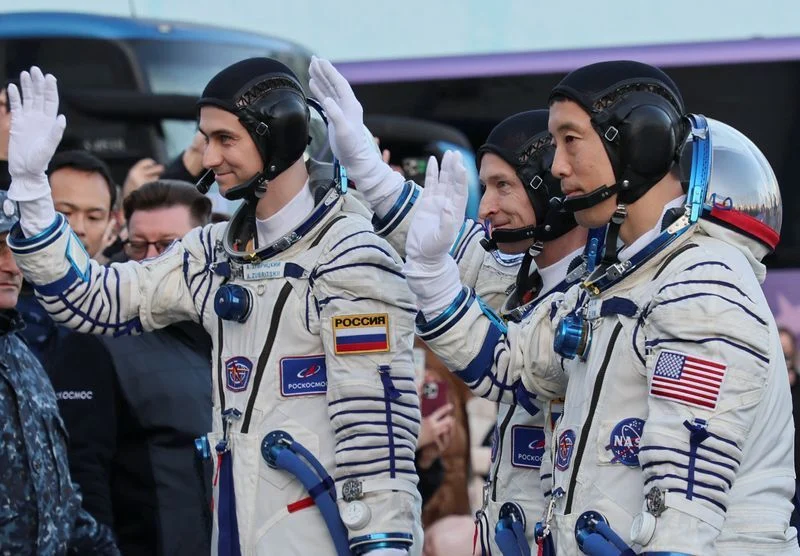

A Russian spacecraft successfully transported American astronaut Jonny Kim and two Russian cosmonauts to the International Space Station (ISS) on Tuesday, in a mission hailed as a testament to ongoing space cooperation between the United States and Russia.
The Soyuz 2.1a rocket lifted off from Kazakhstan’s Baikonur Cosmodrome, carrying Kim along with Commander Sergey Ryzhikov and Flight Engineer Alexey Zubritsky. The spacecraft docked with the ISS just three hours after launch, according to Russia’s space agency, Roscosmos.
Upon arrival, the trio was warmly welcomed by the existing crew onboard the ISS. The station’s population now stands at ten, comprising four NASA astronauts, five Russians, and Japanese astronaut Takuya Onishi.
NASA noted that during his eight-month mission, Kim will engage in a wide range of scientific research, including experiments related to technology, Earth observation, biology, and human health.
The mission has been seen as a rare moment of unity amid broader geopolitical tensions. Kirill Dmitriev, Russian President Vladimir Putin’s investment representative, praised the launch as an example of enduring US-Russian collaboration in space, sharing footage of the liftoff on his official Telegram account.
Dmitriev, who recently met with officials in Washington to discuss revitalizing bilateral ties, pointed to the historic 1975 Apollo-Soyuz mission—the first international human spaceflight—as the foundation of today’s cooperation. That mission marked a significant Cold War-era milestone, symbolized by a handshake between American and Soviet astronauts in orbit.
Despite mounting US sanctions over the conflict in Ukraine, space exploration remains one of the few fields where the two nations continue to work together. Dmitriev also highlighted potential areas of joint development, such as investments in the Arctic, Russian rare earth resources, and even a nuclear power source for a potential Mars mission envisioned by SpaceX CEO Elon Musk.
Looking ahead, Russia is preparing to transition to its own independent space station, with the first two modules expected to launch by 2027. The country is also deepening its collaboration with China on future space endeavors.
